Bayonne Superior Roofing handles chimney repair in Bayonne, NJ, serving surrounding cities including Roselle Park, North Arlington, Guttenberg, East Rutherford and Rutherford. Over 20+ years on local roofs, the brick chimney has been the single most common source of leaks we trace, especially on older houses where the flashing, the crown and the mortar have all been aging alongside the roof.
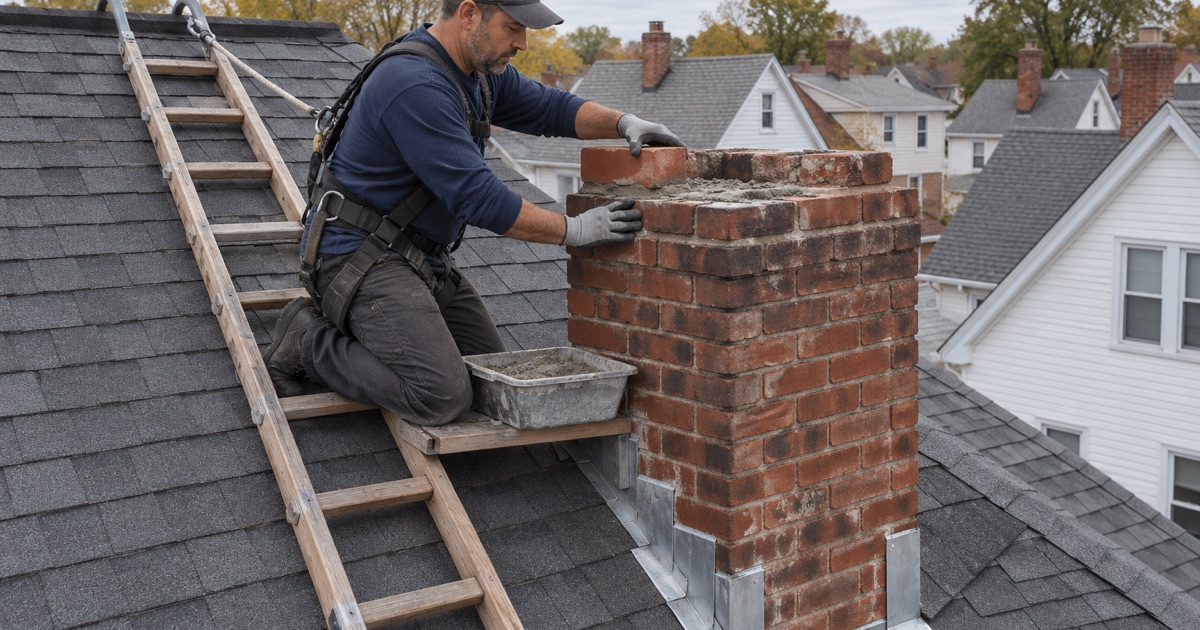
We approach chimney repair as roofers. The chimney is where the roof, the masonry and the flashing meet, and a leak there can come from any of the three. We check the step and counter flashing, the cricket if there is one, the crown and cap at the top and the condition of the brick and mortar above the roofline, then repair whatever has failed.
When a chimney sits on a roof that is due for replacement, we do the chimney work and the roof together. Step, counter and chimney flashing is always replaced with the new roof rather than reused, because old flashing under new shingles is one of the most common reasons a new roof leaks.
Chimney Flashing Repair
Step Flashing and Counter Flashing
Along the sides of a chimney, step flashing is woven in with each course of shingles, one piece per course, so water running down the roof is shed over each piece in turn. Counter flashing covers the top edge of the step flashing and is set into the brick, either in a sawn reglet or a mortar joint, so water running down the chimney cannot get behind it.
When counter flashing pulls loose from the joint or the step pieces rust through, water runs straight down the face of the chimney into the house. We remove the failed pieces, install new step flashing with the shingles and cut a fresh reglet or rake out the joint to set new counter flashing securely.
Apron Flashing on the Downhill Side
The front of a chimney, facing downhill, is covered by an apron flashing that laps over the shingles below. It is often the piece that has been patched most with roof cement, which cracks and opens again within a season or two.
We replace aprons with new metal, folded to fit the chimney and set into the brick with counter flashing above it. Cement is never used as the primary seal, only as an accessory where a manufacturer’s detail calls for it.
Crickets and Saddles
On the uphill side, water and debris coming down the roof hit the back of the chimney and can pile up there. On wider chimneys this creates a small dam where water sits against the brick and works its way under the flashing.
A cricket, or saddle, is a small peaked roof built behind the chimney to split that flow and send it around both sides. We frame, sheathe and flash crickets as part of a chimney repair or a roof replacement wherever the chimney’s width calls for one.
Chimney Crown, Cap and Masonry Repair
Chimney Crown Repair
The crown is the concrete or mortar slab that covers the top of the chimney around the flue. On many older chimneys it was formed with ordinary mortar, which cracks with freeze and thaw and lets water soak straight down into the brick below.
We seal small cracks where the crown is sound and rebuild crowns that are broken or crumbling, forming the new crown so it slopes away from the flue and overhangs the brick slightly. That overhang keeps water dripping clear of the chimney face instead of running down it.
Chimney Caps
A chimney cap covers the top of the flue to keep rain, snow and animals out while letting smoke and gases escape. An open flue lets water fall straight down the chimney, where it damages the liner and the masonry from inside.
We install metal caps sized to the flue or covering multiple flues, fastened so they stay put in high winds. On chimneys that serve gas appliances, the cap must suit that use, and we confirm what the chimney serves before choosing one.
Repointing and Rebuilding Above the Roofline
Mortar joints on the exposed part of a chimney wear out long before the brick does. Open joints let water into the masonry, and in winter that water freezes, spalls the brick face and loosens more mortar.
We rake out failed joints and repoint them with mortar compatible with the existing brick, which matters on older chimneys where a hard modern mortar can damage soft historic brick. When the brick above the roof is loose or badly spalled, we rebuild that section and reset the flashing into the new masonry.
Chimneys on Older and Two-Family Houses
Prewar Chimneys and Their Roofs
Many houses in the area were built before 1940, and their brick chimneys have been through decades of weather and several roofs. Each reroof that reused the old flashing or added another layer around it made the chimney detail worse, so we often find layers of cement and patched metal that need to be stripped back to the brick.
On those houses, rebuilding the flashing properly once is far cheaper than chasing the same leak every year. We photograph what we find under the old patches so you can see why the work is needed.
Chimneys on Shared Walls
On attached houses and some closely built two-family houses, chimneys sit on or near the wall shared with a neighbor. A leak there may come from either side of the line, so we trace it on both roofs, with permission, before deciding which chimney detail or flashing is responsible.
Removing an Unused Chimney
Many older houses have a chimney that no longer serves any appliance. It still needs flashing, a crown and repointing to stay watertight. Taking an unused chimney down below the roofline and decking over the opening removes a common leak point for good, provided no other flue depends on it and the work is planned with any permit it requires.
- 20+ Years in Roofing
- Line-Item Written Estimates
- Daily Nail-Magnet Cleanup