Bayonne Superior Roofing provides commercial roofing in Bayonne, NJ, serving surrounding cities including Roselle Park, North Arlington, Guttenberg, East Rutherford and Rutherford. Our 20+ years in the trade include the flat and low-slope roofs on storefronts with apartments above, small offices, multifamily buildings, warehouses and the mixed-use blocks that line many local commercial streets.
Commercial roofs fail differently from houses. They carry rooftop HVAC units, exhaust fans and hatches, drain through scuppers and interior drains instead of open gutters, and are bordered by parapet walls whose coping and flashing take weather from every side. We treat all of those parts as the roof, not as someone else’s problem at the edge of the membrane.
Every commercial job comes with a written scope that separates tear-off, insulation, membrane, flashing and drainage into their own lines. Building owners and managers can compare bids accurately, plan budgets and keep a clear record for the property file.
Commercial Flat Roof Systems
Modified Bitumen Roofing
Torch-down SBS and APP modified bitumen is a reinforced asphalt membrane installed in overlapping rolls, with the seams heat-welded together. It is common on older local commercial roofs, stands up well to foot traffic and is straightforward to repair, which makes it a good fit for roofs that technicians walk across to service equipment.
We install multi-ply modified bitumen systems with a granulated cap sheet and flash every curb, pipe and wall into the membrane. On buildings where an open flame near combustible materials is a concern, self-adhered and cold-applied options are available.
EPDM Rubber Roofing
EPDM is a synthetic rubber membrane supplied in large sheets, so a roof can be covered with relatively few seams. It stays flexible in cold weather and suits large, open roofs with few penetrations, such as warehouses and low commercial buildings.
Seams are bonded with primer and seam tape, and the membrane is fully adhered or mechanically fastened depending on the deck and the wind exposure. We pay particular attention to the perimeter, where EPDM needs secure termination to resist uplift.
TPO and PVC Single-Ply Roofing
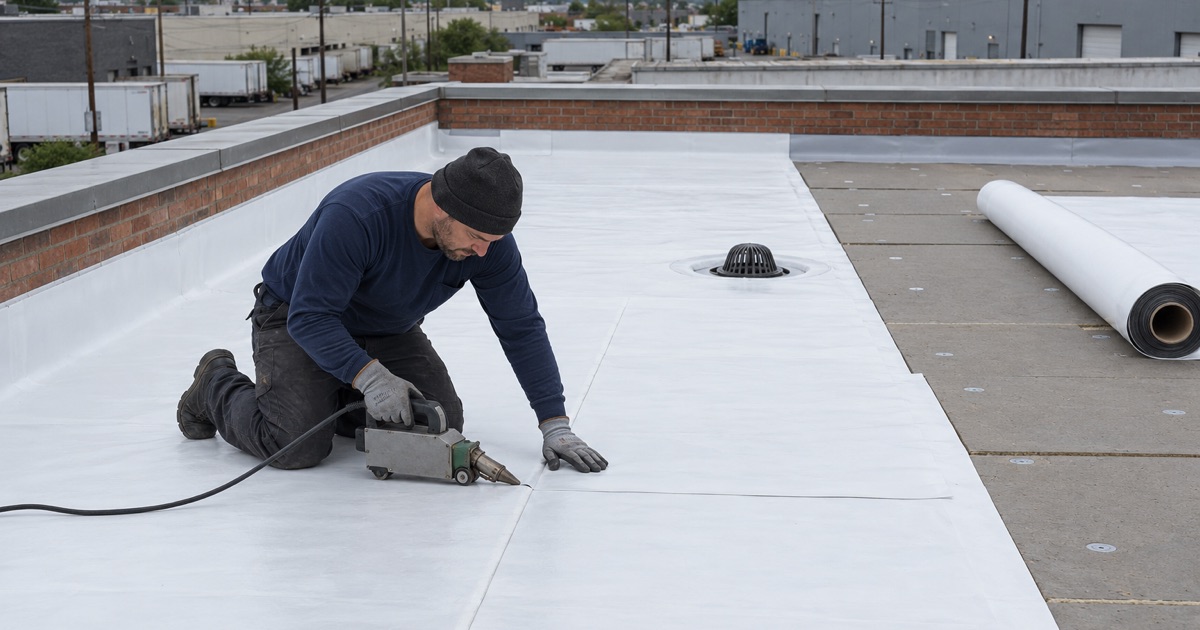
TPO and PVC are single-ply thermoplastic membranes whose seams are welded with hot air, forming a continuous sheet that is often stronger at the seam than the membrane itself. Both are typically white or light colored, reflecting sun and reducing heat gain under the roof.
PVC holds up well where a roof is exposed to grease and chemicals, such as over a restaurant kitchen exhaust. TPO is a common choice for general commercial roofs. We recommend between them based on what the roof will be exposed to.
Built-Up Roofs and Roof Coatings
Many older buildings still have built-up roofs made of alternating layers of felt and asphalt topped with gravel. We repair them where they are sound and replace them when they are not. On roofs whose membrane is intact and whose insulation is dry, a roof coating can extend service life; on roofs with wet insulation or failed seams, a coating only hides the problem.
Mixed-Use, Multifamily and Association Buildings
Storefronts With Apartments Above
Mixed-use buildings combine a business on the ground floor with tenants upstairs, and a roof project affects both. We schedule work around store hours and give residential tenants notice of when the crew will be overhead and when access to the top floor may be needed.
These buildings often have a front parapet or mansard facing the street and a flat roof behind it. We check the joint between the two, the coping on the parapet and the drainage at the rear, because those three areas account for many of the leaks we are called to.
Condo and Co-op Roofs
New Jersey’s Structural Integrity Law, P.L.2023, c.214, requires covered associations to carry out reserve studies, and the roof is among the largest capital items in them. We provide written inspection findings and photos that a board can share with the professional preparing its study, along with itemized repair or replacement estimates for budgeting.
Permits for Commercial and Larger Residential Buildings
New Jersey’s ordinary maintenance exemption for roof coverings is limited to detached one- and two-family dwellings. Commercial buildings, mixed-use buildings and residential buildings with three or more units fall outside it, so we plan permit applications with the Bayonne Building Department at 630 Avenue C into the schedule.
Edges, Drainage and Rooftop Equipment
Parapets, Coping and Through-Wall Flashing
Parapet walls are exposed on three sides, and water that gets past failed coping or open mortar joints runs down inside the wall. We reset or replace coping, repair through-wall flashing and carry the membrane up the wall with proper counter flashing, so the top of the wall stays sealed.
Drains, Scuppers and Conductor Heads
A flat roof is only as good as its drainage. We clear and reflash interior drains and scuppers, replace damaged conductor heads and leaders and use tapered insulation to correct low spots where water ponds. Every outlet is tested with water before a repair or replacement is called finished.
HVAC Curbs, Hatches and Edge Wind Uplift
Rooftop units, exhaust fans, pipe stacks and roof hatches are each flashed into the membrane on curbs or with boots, and walkway pads protect the roof where service technicians walk. Around the perimeter, edge metal and membrane terminations are fastened to resist wind, since uplift is strongest at the edges and corners of a flat roof.
The crew works under OSHA fall protection rules on every commercial roof, with warning lines or guardrails set back from unprotected edges and skylights covered or guarded, so the work proceeds safely around your building and its occupants.
- 20+ Years in Roofing
- Line-Item Written Estimates
- Daily Nail-Magnet Cleanup