Bayonne Superior Roofing handles flat roof repair in Bayonne, NJ, serving surrounding cities including Roselle Park, North Arlington, Guttenberg, East Rutherford and Rutherford. With roughly 32.3 percent of the city’s housing units in two-unit buildings, a large share of our 20+ years of repair work has been on the flat or low-slope roof that sits behind the pitched front of a two-family house.
That rear roof is easy to forget. It cannot be seen from the street, it often covers a kitchen or a back bedroom, and it usually drains through a scupper, a box gutter or a single leader that clogs with leaves. When it leaks, the usual response is a bucket of roof cement on the visible spot, which seldom reaches the actual cause.
We check a flat roof at its seams, along the parapet coping and at the drain or scupper, not only at the patch where someone saw water. Then, before a repair is called finished, the drains, scuppers and leaders are cleared and run with water so we know the roof can actually shed what falls on it.
Repairs by Flat Roof Type
Torch-Down Modified Bitumen Repairs
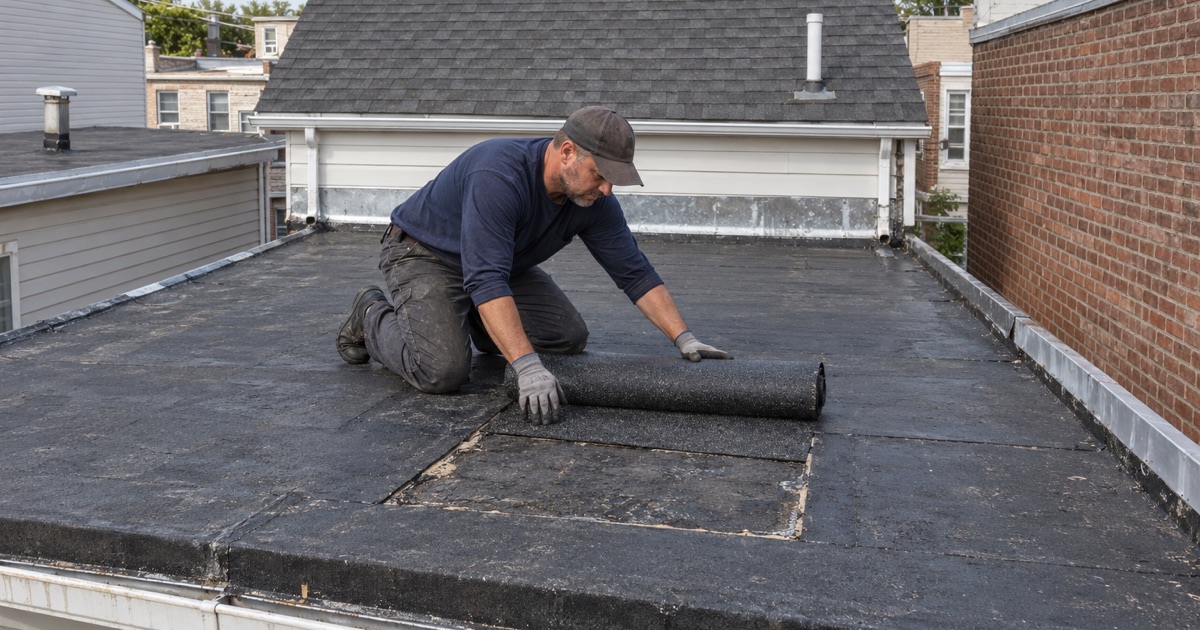
Torch-down SBS and APP modified bitumen is the most common membrane on older local flat roofs. Its weak points are the overlapping seams, which can open as the asphalt ages, and the cap sheet surface, which loses granules and cracks under sun and foot traffic.
We repair open seams by reheating and resealing them or by welding a new strip over the joint, and we patch cracked areas with new cap sheet cut well beyond the damage. Where blisters have formed, we cut them open, dry and reseal the area rather than leaving a soft spot that will split later.
EPDM Rubber Roof Repairs
EPDM is a single sheet of synthetic rubber with relatively few seams, so leaks usually come from seam tape that has lost adhesion, shrinkage pulling the membrane away from the walls and edges, or punctures from dropped tools and branches.
We clean and prime the rubber before applying new seam tape or patches, because EPDM will not bond to anything on a dirty or weathered surface. Where shrinkage has pulled the membrane tight at the perimeter, we add new flashing strips so the corners are not under tension.
TPO, PVC and Built-Up Roof Repairs
TPO and PVC repairs are heat-welded with hot air, using matching membrane so the patch fuses into the existing sheet. On older built-up roofs with gravel surfacing, we clear the gravel from the damaged area, rebuild the plies and reset the surface over the repair.
Where Flat Roofs Leak
Parapet Walls and Coping
Where a flat roof meets a parapet wall, the membrane turns up the wall and is covered by counter flashing and coping. If the coping joints open or the counter flashing pulls away, water runs down behind the membrane and into the house below, often far from where it entered.
We reset or replace loose coping, repoint open joints, reseal the counter flashing and repair the membrane where it turns up the wall. On shared parapets between attached houses, we check both sides before deciding which roof is the source.
Where the Pitched Front Meets the Rear Roof
On many two-family houses, the shingled front roof drains onto the flat rear section, delivering a lot of water to one joint. That transition is a frequent leak point because shingles, flashing and membrane all meet there.
We rebuild the transition with proper flashing tied into both roofs and make sure the water coming off the pitched section has a clear path to the outlet. Patching only one side of the joint usually moves the leak a few feet rather than stopping it.
Penetrations, Hatches and Rooftop Units
Plumbing vents, exhaust fans, roof hatches, skylights and air conditioning units all pass through the membrane. Each one is flashed with a boot, a curb or a pitch pocket, and each can leak when that flashing ages or is disturbed during equipment service.
We replace failed boots and curb flashing with materials compatible with your membrane, and we add walkway pads between the hatch and any equipment so service visits stop wearing through the roof.
Drainage on Flat Roofs
Ponding Water and Slope
Water that stays on a flat roof after a storm adds weight, breaks down the membrane faster and finds the smallest opening. We locate low spots and correct them where the roof allows, with tapered insulation, crickets that direct water toward the outlet or an added drain.
Scuppers, Box Gutters and Leaders
A scupper through a parapet, a box gutter along the eave or a single leader at a back corner may be the only way water leaves a small rear roof. We clear them, reflash their connection to the membrane, replace damaged conductor heads and leaders and then test the full path with water.
Coatings and Knowing When to Replace
When a Roof Coating Makes Sense
A roof coating can extend the life of a sound flat roof by sealing weathered surfaces and reflecting sun. It does not repair wet insulation, open seams or a roof that ponds, so we check the membrane and probe for moisture before recommending one.
Repair Versus Replacement
If the membrane is cracked across the whole roof, if large areas are wet underneath or if the roof has been patched many times over, a replacement usually costs less than continuing to repair it. We give you a straight answer and price both options so you can compare them.
- 20+ Years in Roofing
- Line-Item Written Estimates
- Daily Nail-Magnet Cleanup