Bayonne Superior Roofing brings more than 20 years of work to roofing in Highland Park, and most of the roofs we are asked to look at here belong to someone who does not sleep under them. That changes how a job is scoped, scheduled and explained, so this page reads more like a briefing for building owners than a brochure.
Whether you own a three-family on a side street or a detached house you live in yourself, we start in the same place: a straight answer on whether the roof can be repaired, given before replacement comes up at all. When it cannot, you get a written scope that breaks tear-off, decking, underlayment, flashing and drainage into separate lines, so a second estimate can be laid beside ours and compared one item at a time.
What follows covers what makes the work different in this borough: who usually signs the contract, why the type of building decides whether the borough reviews the job, and how local rental rules affect when a roof gets done.
A Borough of Three- and Four-Unit Buildings
Highland Park is a borough in Middlesex County on the northern bank of the Raritan River, across from New Brunswick. Its housing leans heavily toward renting: of 6,436 occupied homes, 3,843 are rented, or 59.7 percent, according to the Census Bureau’s 2024 five-year American Community Survey. Detached single-family houses account for roughly a third of the borough’s units.
The figure that shapes our work most is the middle of the market. Some 1,310 units, or 19.4 percent of the borough’s 6,759 housing units, sit in buildings with three or four apartments. Of the occupied units in those buildings, 1,293 are rented and just 17 are lived in by an owner. In practical terms, the person deciding what happens to a three- or four-unit roof here is almost always a landlord.
What a landlord needs from a roof visit
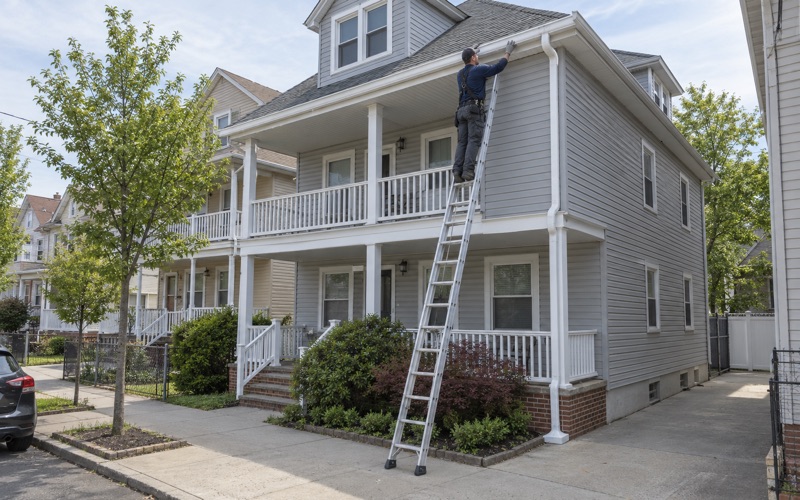
An owner who lives elsewhere usually hears about a roof through a tenant’s text about a ceiling stain. We do not price anything from that message or from the ground. Every leak call includes a look inside the top-floor apartment or the attic as well as on the roof itself, so the water is traced to the point where it actually gets in. On a multifamily building that often means a stain two rooms away from where the problem sits.
You get the findings in writing with photographs, which matters when you are deciding from a distance. If wind or hail did the damage, we document it for your own insurance claim and will meet the adjuster at the building when you ask us to.
Working around the people who live there
A roof over three or four households is a roof over three or four schedules. The habit we keep on two-family houses, telling the upstairs tenant when the crew arrives and where access will be needed, scales up here to every unit in the building. Notice goes out before the first tear-off day, not on the morning of it.
Tenants also walk out the front door onto whatever we leave behind. The sidewalk, yard and gutters are cleaned at the end of each working day, including a magnet sweep for roofing nails, so nobody’s tire or shoe finds one.
Looking for roofing closer to Dumont? See Dumont Roofing.
Why a Three-Family Roof Is Permit Work
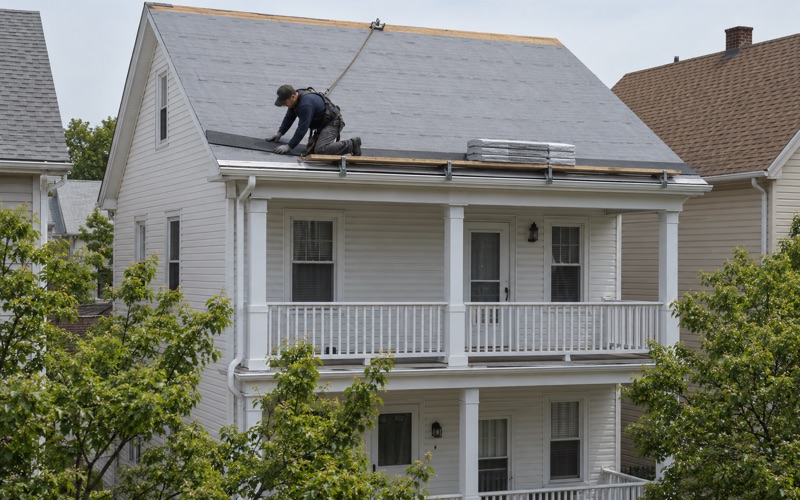
New Jersey’s Uniform Construction Code treats repair or replacement of roof covering on a detached one- or two-family dwelling as ordinary maintenance under N.J.A.C. 5:23-2.7(c)1.x: no permit, no inspection and no notice to the construction office. A building with three or four units is not named in that item. It is neither detached one-family nor two-family, so re-roofing it falls outside the exemption and needs a construction permit.
In Highland Park that permit comes from the Building & Construction Division, which administers and enforces the state code along with the municipal code. The division requires every permit application to be paid before a permit is issued and an inspection is scheduled, and it does not take credit cards or online payments. Its construction office can be reached at 732-777-6013.
Building the permit into the schedule
On a three- or four-family job we treat the permit as part of the timeline rather than a step to squeeze in. The tear-off date is set after the permit is in hand, not before, and the payment method is sorted in advance so the application does not stall at the counter. Tenants hear a start date only once that date is real.
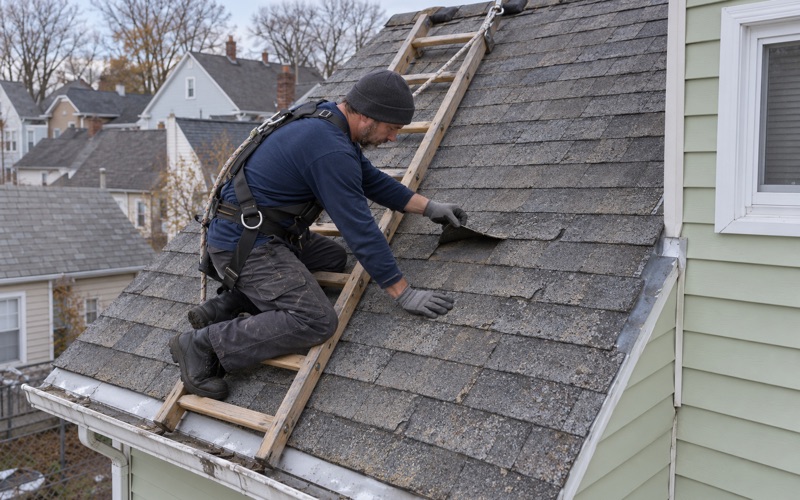
The state rehabilitation subcode also limits layering. Where a roof already carries two or more layers, or the existing covering is slate, wood shake or tile, the old material comes off before anything new goes on. Older multifamily buildings sometimes reveal a second layer only once a test cut is made, so we check before quoting rather than after.
What the written scope shows
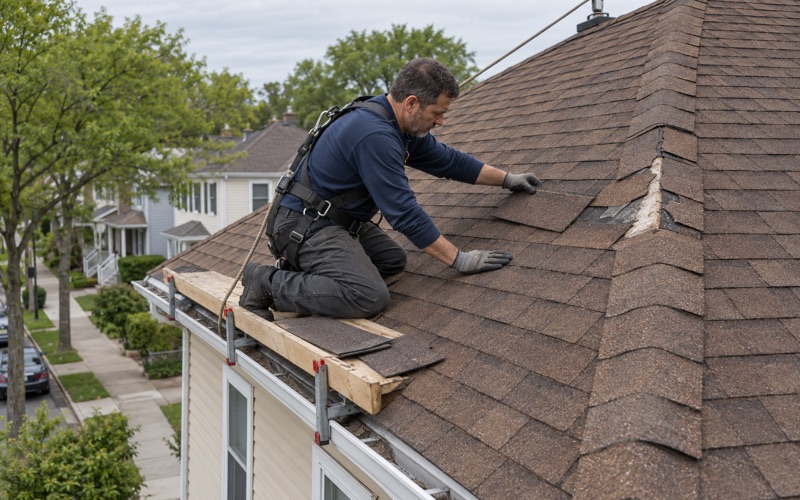
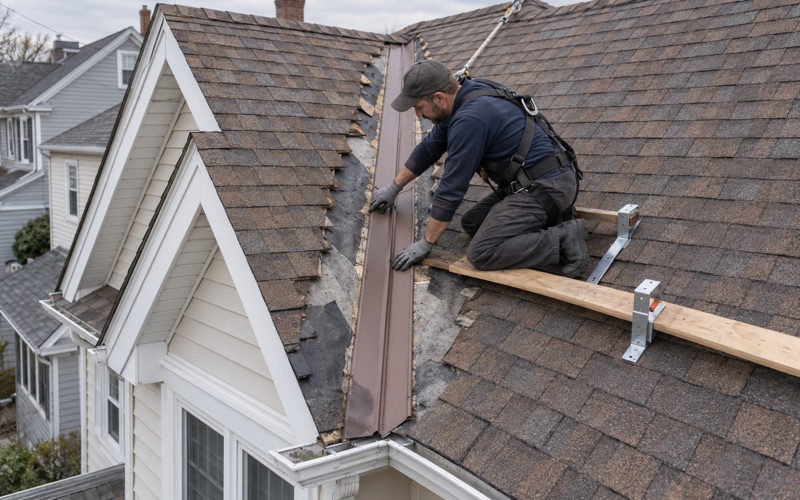
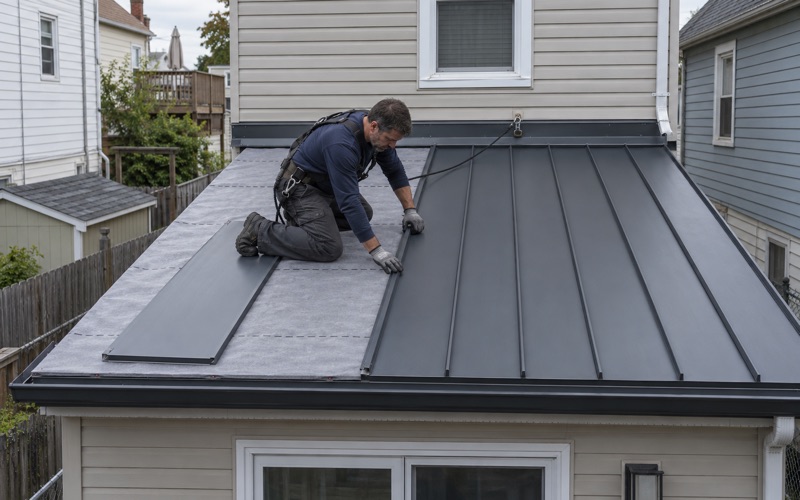
Because a permitted job has more steps, the paperwork has to keep up. Decking that turns out to be damaged once the old roof is off is photographed and shown to you before it is replaced, at a per-sheet price already set in the contract. Step flashing, counter flashing and chimney flashing are replaced with the roof instead of being bent back over new material.
Low-slope rear sections
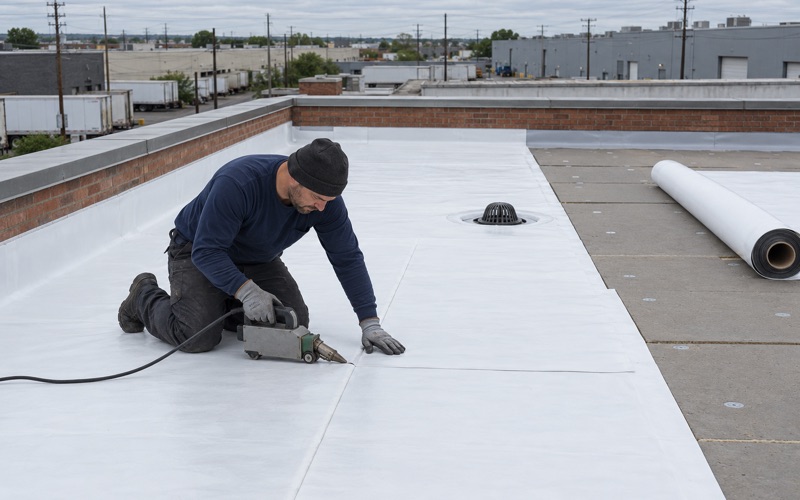
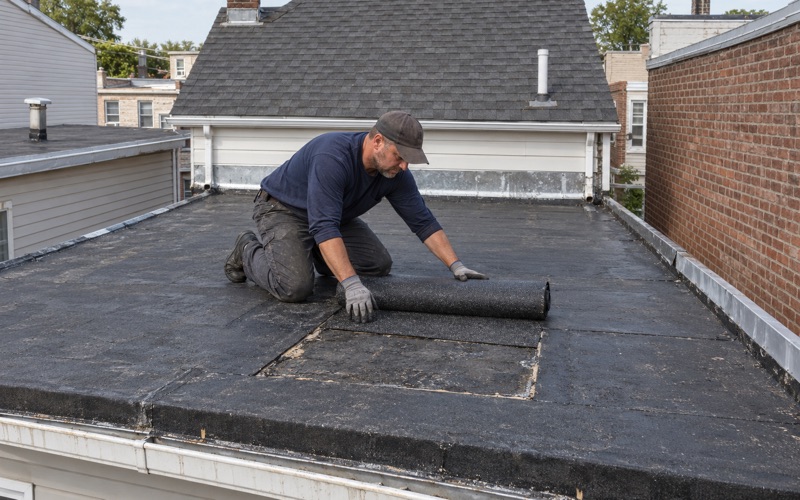
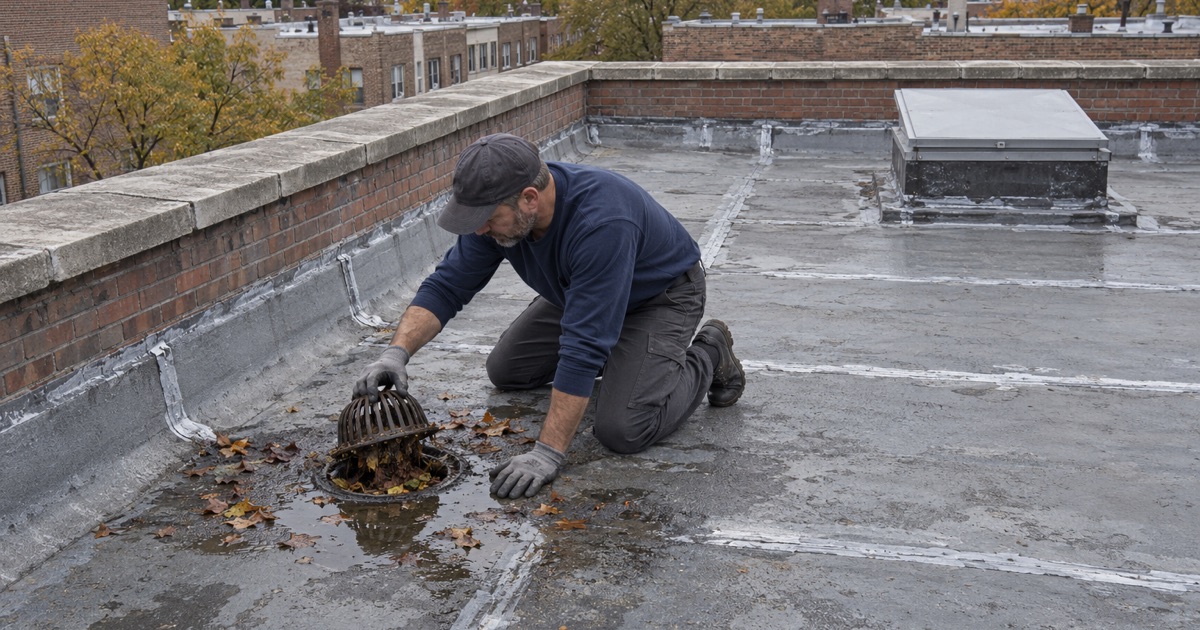
Plenty of multifamily buildings pair a pitched front with a low-slope roof over the rear. Those sections fail at the seams, at the parapet coping and at the drain or scupper long before the middle of the field gives out, so that is where we look, not just at the patch someone left last time. Box gutters, scuppers and leaders are cleared and run with water before a flat-roof repair is called finished.
Rental Inspections, Rent Control and Planning a Roof
Owning rentals in Highland Park comes with a set of borough rules that have nothing to do with roofing directly but shape when roofing gets done. The borough’s Property Maintenance office handles rental registration and change-of-occupancy inspections. Registration, the lead-based paint requirement, liability insurance and the rental application must all be paid in full before an inspection is scheduled and a rental certificate issued, and the unit has to be empty for that inspection.
Using a vacancy well
A unit between tenants is the easiest time to trace a slow leak. With nobody living in the top-floor apartment, we can open closets, look along ceiling lines and get into the attic hatch without rearranging someone’s household. We cannot tell you what a housing inspector will or will not cite, but a water stain is a lot easier to explain when you already know where it came from and what it costs to stop.
Rent control and budgeting
Since December 20, 2022, Highland Park’s Ordinance 22-2066 has governed rent increases on rental dwellings, including one- to four-family units. Annual increases are tied to the consumer price index and capped at 5 percent; the borough set 3.80 percent for 2024 and 3.55 percent for 2025. A Rent Control Board made up of tenants, landlords and homeowners oversees it.
We are roofers, not housing counsel, so we do not advise on how the ordinance treats any particular expense. Questions about that belong with the Rent Control Board or your own attorney. What we can do is help with the budget side. When rent growth is limited, knowing whether a roof has two more years in it or needs replacing this season is worth a great deal, and an itemized scope lets you plan the larger job instead of reacting to it.
Contracts and older paint
Our contracts are written to New Jersey’s home improvement rules, including the notice of your three-business-day right to cancel. On buildings put up before 1978, painted fascia and trim that has to be disturbed is handled under the EPA’s lead-safe renovation rule. That covers a large share of the borough: 1,854 of its 6,759 units, about 27.4 percent, were built in 1939 or earlier.
Detached Houses and Two-Families in Highland Park
Not every roof here sits over tenants. Detached single-family houses make up about a third of the borough’s homes, most of them owner-occupied, and another 487 units sit in two-unit buildings. For these buildings the state rule works the other way: replacing the roof covering on a detached one- or two-family dwelling is ordinary maintenance, with no permit, inspection or notice required.
That does not make the job casual. The same tear-off limits apply, and the same scope lines appear on the estimate. Owners of a detached house get the repair-or-replace answer first, just as a landlord does.
Two-family houses
Two-family homes are scheduled with both units in mind. If the upstairs is rented, that tenant learns when the crew arrives and which rooms we may need to reach, so access is arranged before anyone is standing at the door. Where a house shares a wall with its neighbor, a leak along that party wall is traced on both sides of the line before either roof takes the blame.
Older streets and historic districts
Highland Park was formed as a borough in 1905, and older houses are common on the residential streets around Raritan Avenue. The Livingston Manor Historic District has been on the National Register of Historic Places since 2004, and the Greek Revival Livingston Homestead on Harrison Avenue is individually listed. National Register listing on its own does not regulate what a private owner puts on a roof, but an older house often hides layered flashing, a tired chimney crown or a cricket that was never built, and we look for all three.
Solar, chimneys and the details that outlast shingles
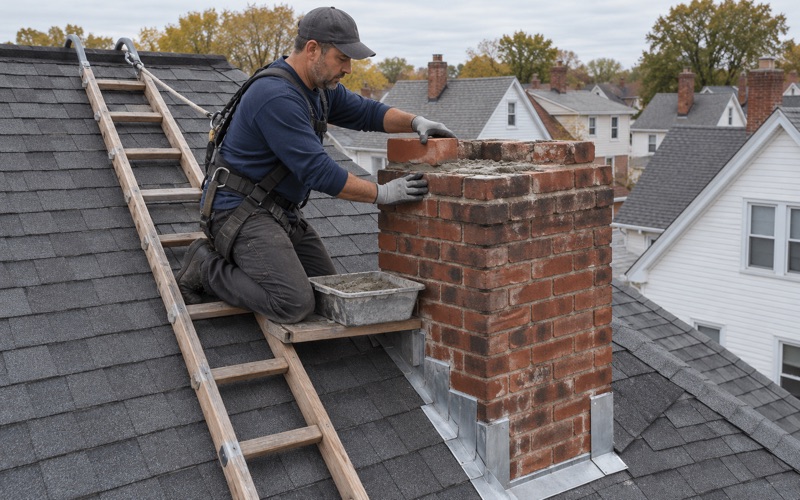
When panels are already on the roof, removing and reinstalling them is written into the schedule from the start rather than discovered on the first morning. Chimneys get a look at the crown and cap as well as the flashing, and pipe boots are replaced rather than reused. Those small parts are where a new roof most often leaks first, so they are part of the job and not an extra.
- 20+ Years in Roofing
- Line-Item Written Estimates
- Daily Nail-Magnet Cleanup