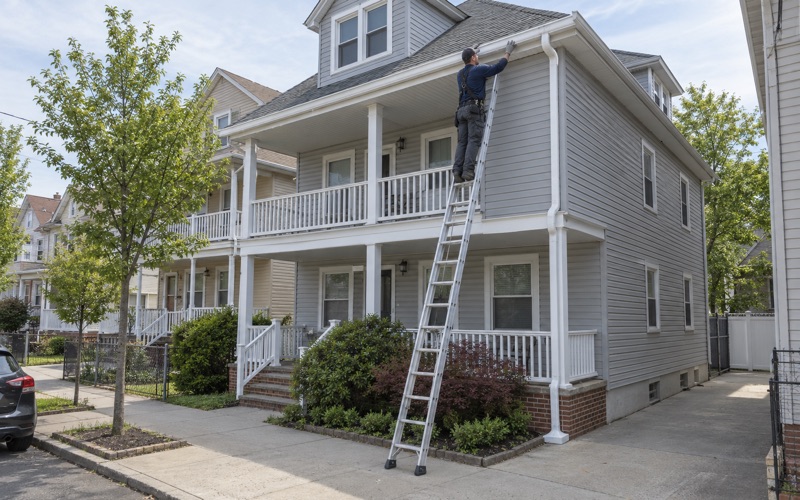
Bayonne Superior Roofing has spent more than 20 years on roofing in Little Ferry, and in this borough the building under the roof is often an apartment house rather than a single home. For the owner of a three-family, a garden-apartment court or a mid-size block, a roof is not a project to schedule when the budget allows. It is part of a maintenance duty the state writes down.
That changes how we approach the job. Before anyone talks about a new roof, we find out whether the existing one can be repaired, and we trace every leak from the inside as well as the outside. A wet stain on a fourth-floor ceiling and a blister on the membrane above it are not always the same problem.
What follows is how we handle roofs on multifamily buildings in the borough: what the code expects, where the water usually gets in, and how the paperwork runs through the Building Department.
Apartment Roofs and the State Maintenance Code
How much of the borough lives under a shared roof
The housing count explains why this matters here. According to the Census Bureau’s 2024 five-year American Community Survey, 1,918 homes in Little Ferry, or 40.7 percent, are in buildings with three or more units. Another 922 units sit in buildings of 10 to 49 apartments, the garden-apartment and mid-size blocks that make up much of the rental stock. Detached houses account for 1,612 units, fewer than the apartment total.
Under New Jersey’s Hotel and Multiple Dwelling Law, any building with three or more units meant to be lived in independently is a multiple dwelling. That definition pulls a plain three-family into the same regulatory family as a fifty-unit complex. The owner of either one answers to the same maintenance rules.
What N.J.A.C. 5:10-7.4 actually says
The state’s Regulations for Maintenance of Hotels and Multiple Dwellings speak to roofs directly. Section 5:10-7.4 says roofs, skylights, exterior walls, windows, foundations and other parts of the structure “shall be maintained as to keep water from entering the structure.” It goes on: “Damaged or badly worn material shall be repaired or replaced.”
The same section asks that places showing rot, leakage, deterioration or corrosion be treated or restored so weathering and seepage stop. Read plainly, a leaking roof on a multiple dwelling is not a cosmetic issue an owner can defer. Keeping water out is the standard, and worn material that no longer does that has to be dealt with.
Why the wording favors early repair
The code does not require a new roof at the first sign of trouble. It requires a roof that keeps water out. That gives an owner room to repair a failed seam, reflash a parapet or replace a section of worn membrane instead of tearing off a whole building, as long as the repair actually stops the water. We give a straight answer on whether a repair will do that before replacement ever comes up.
Looking for roofing closer to Wallington? See Roofing in Wallington.
Rot, Leakage and Worn Roofing Material
Where apartment roofs usually fail
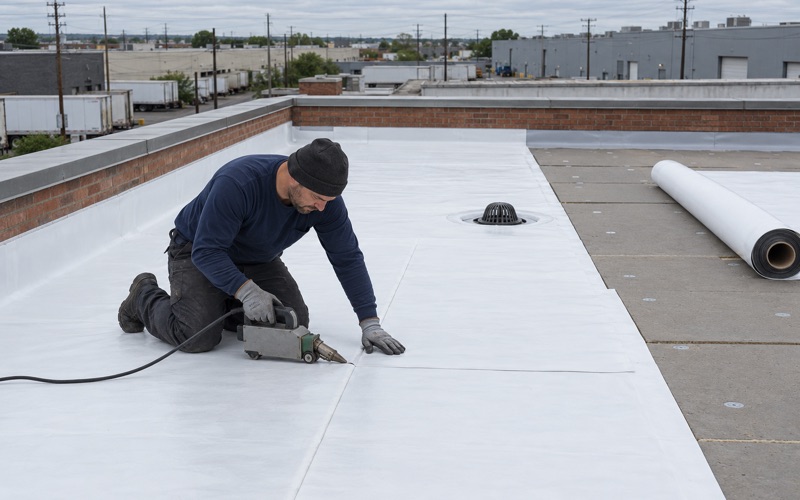
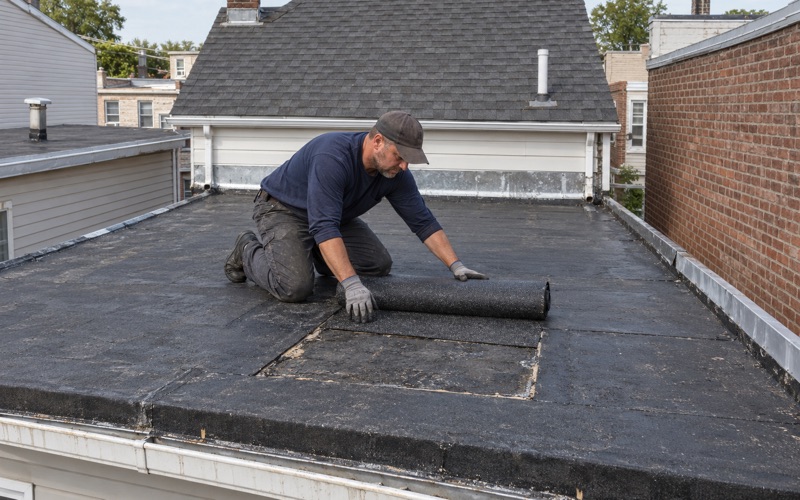
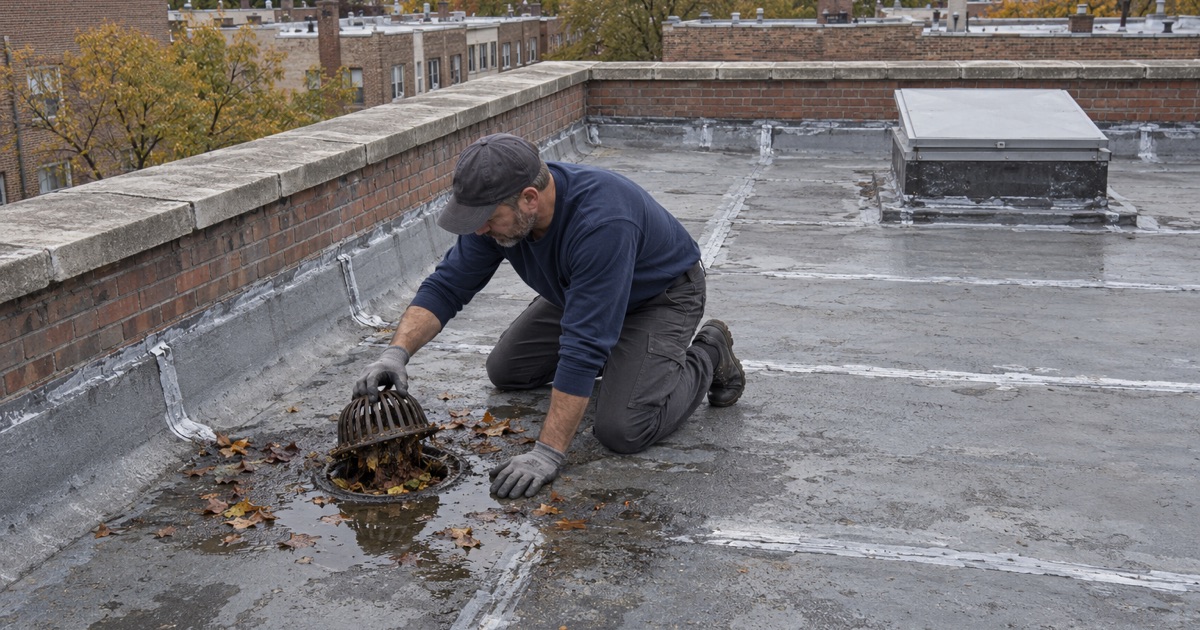
Garden-apartment and mid-size blocks are commonly topped with low-slope roofs, and those fail in predictable places. The open field of the membrane is rarely the culprit. Water tends to get in at the seams, at the parapet coping, around rooftop penetrations and at the drain or scupper where it is supposed to leave.
That is why we check those points on every low-slope call, not only the patch a tenant pointed at. A built-up roof with a split at the base of a parapet, an EPDM membrane pulling away at a lap, or a torch-down modified bitumen roof with a failed flashing around a vent pipe can all send water several feet along the deck before it shows up below.
Tracing the water from the top floor
Every leak call includes a look in the attic or at the top-floor ceiling as well as on the roof. In an occupied building that usually means coordinating with the tenant in the affected unit, and we arrange access in advance so nobody is surprised by a crew at the door.
Where two buildings share a party wall, we look at both sides of the line before blaming either roof. A leak that appears in one owner’s unit sometimes enters through a neighbor’s coping or flashing, and the fix belongs where the water gets in.
Skylights, hatches and rooftop equipment
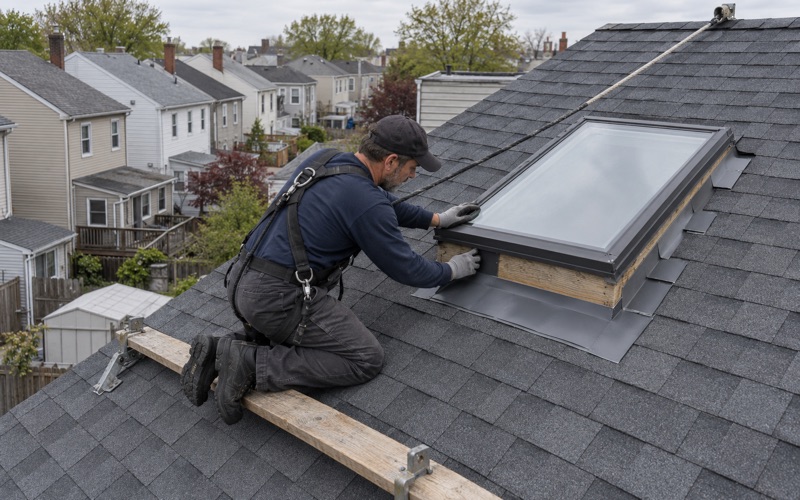
The maintenance code names skylights alongside roofs, and on apartment buildings they are a frequent weak point. A curb-mounted skylight over a stairwell or a roof hatch at the top of a ladder sits in a curb that has to be flashed into the membrane, and that joint moves with every season. Once the sealant dries out, water runs down the inside of the curb and shows up on a landing well away from the opening.
We check the curb flashing, the counterflashing above it and the condition of the glazing or hatch cover itself. Exhaust fans, vent stacks and other penetrations get the same look, since pipe boots are among the first details on a low-slope roof to wear out.
Drainage, gutters and worn flashing
Ponding water speeds up wear on any flat roof, so drainage is part of the repair rather than an afterthought. Box gutters, scuppers, conductor heads and leaders are cleared and then tested with water before we call a flat-roof repair finished.
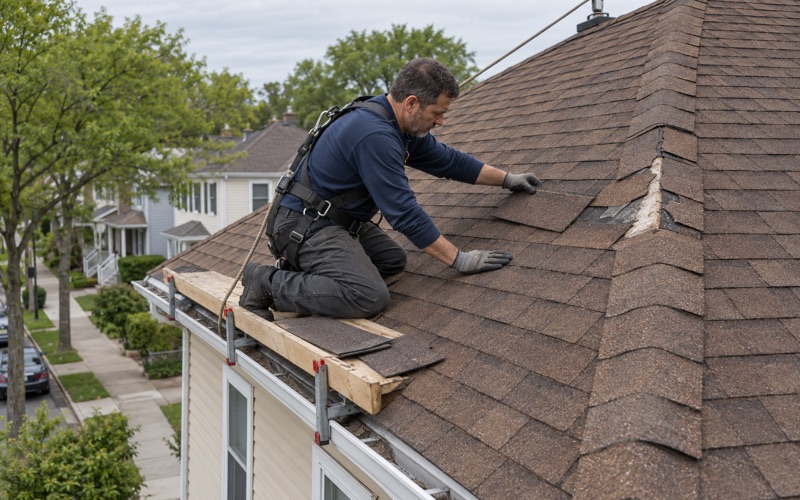
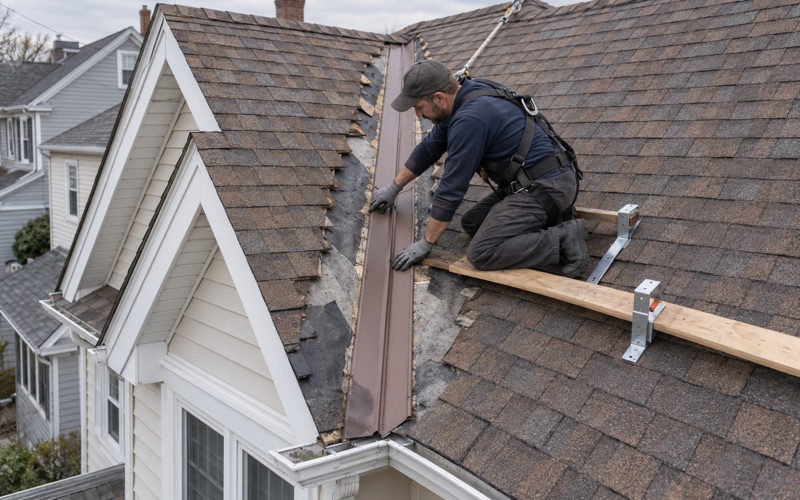
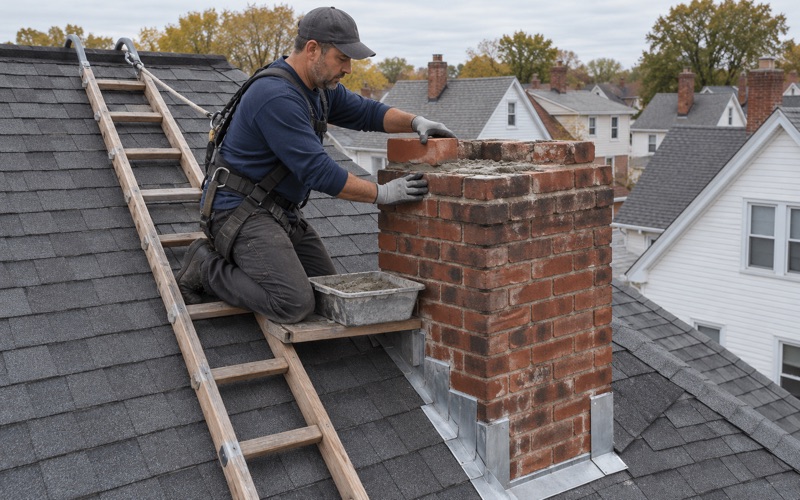
On the sloped sections some older buildings carry, we replace step, counter and chimney flashing along with the roofing instead of reusing it under new material. Old flashing is a common source of the slow, recurring leak that the maintenance code treats as worn material needing repair or replacement.
Decking, hidden rot and the replacement choice
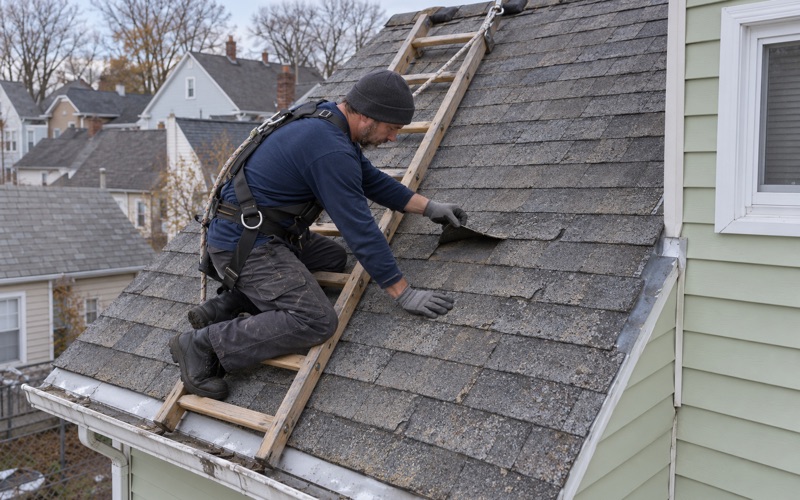
Rot often stays hidden until the old roof comes off. When we find damaged decking, we photograph it and show it to the owner before replacing anything, and the price per sheet is already set in the contract. Our written scopes break out tear-off, decking, underlayment, flashing and drainage as separate lines, so a building owner comparing bids can line them up item by item.
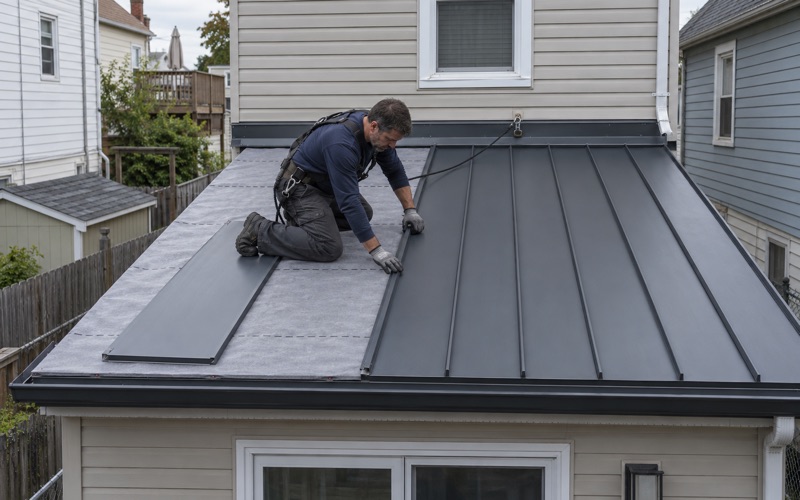
When repair no longer keeps water out, the replacement choice depends on the building. Torch-down SBS or APP modified bitumen, EPDM rubber and TPO or PVC single-ply membranes all have a place on low-slope apartment roofs. We explain how each would handle the existing drains and parapets on that specific roof rather than steering every building to one product.
Roof Work and the Cyclical Inspection
Who inspects multiple dwellings
New Jersey runs a cyclical inspection program for multiple dwellings through the Department of Community Affairs’ Bureau of Housing Inspection. State law, P.L.2019, c.202, set up a tiered schedule for those inspections based on how violations at a building were handled. The regulations also allow the work to be delegated to a municipality or county, which then inspects the buildings the Bureau schedules each state fiscal year.
We do not know where any particular building in the borough sits in that rotation, and we will not guess. An owner who wants to know should ask the Bureau of Housing Inspection directly.
Treating the roof as a standing duty
What we can say is that a roof on a three-plus-unit building is going to be looked at under a code that says water must stay out. An inspection is a poor time to find a soft spot over a stairwell or a scupper rusted through. The practical approach is to have the roof walked on a regular basis, keep the drains clear and fix small failures while they are still small.
When we walk a multifamily roof, the owner gets photographs of what we found and a written list that separates what needs attention now from what can be planned. That record also helps when an owner is setting priorities across several buildings.
Larger buildings and capital planning
For associations and owners of larger blocks, a roof is often the biggest single line in long-term planning. New Jersey’s Structural Integrity Law, P.L.2023, c.214, brought reserve study requirements for certain associations, and a roof is the kind of component those studies plan for. A clear written condition report makes that planning easier, whatever the building’s schedule.
Filing Roof Work With the Little Ferry Building Department
Which jobs need a filing
Permits depend on the building type. Replacing the roof covering on a detached one- or two-family house is ordinary maintenance under N.J.A.C. 5:23-2.7 and does not need a permit. Roofs on buildings of three or more units, attached dwellings and commercial buildings are different: that work goes to the Building Department as a permit or minor-work filing.
Since so much of Little Ferry’s housing is in three-plus-unit buildings, a large share of roof work in the borough goes through that office. The state’s rehabilitation subcode also sets re-roofing rules, including a full tear-off when a roof already carries two or more layers.
How the borough handles it
The Little Ferry Building Department enforces the New Jersey State Uniform Construction Code, and Keith Dalton serves as Construction Official. Permit and inspection requests go through the online portal at sdlportal.com, and the department links the Department of Community Affairs construction permit application packet. Borough offices are open Monday through Friday from 8:30 a.m. to 4:30 p.m.
We prepare the scope that goes with a filing so it matches what the crew will actually do. If the work grows once the roof is open, the owner hears about it before the scope changes.
On the job and after
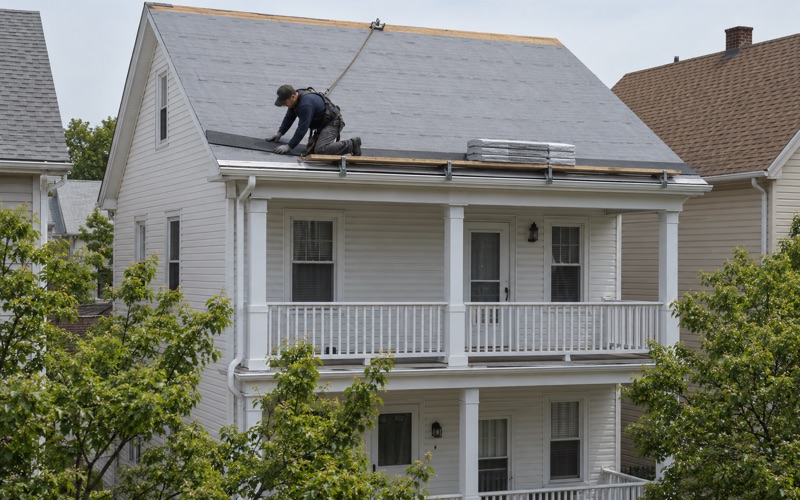
Occupied buildings need a careful site. Our crew cleans the sidewalk, yard and gutters at the end of every work day, with a magnet sweep for roofing nails, which matters where tenants and children walk past the building. Rooftop solar is planned into the schedule, including panel removal and reinstall.
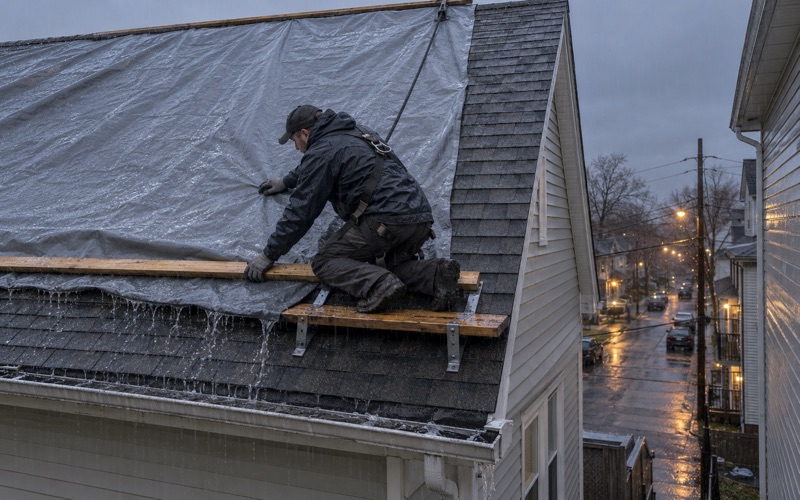
Every contract follows New Jersey’s home improvement rules, including the three-day cancellation notice. If storm damage is part of the picture, we photograph it and write it up for the owner’s claim, and we will meet the insurance adjuster on site when asked.
- 20+ Years in Roofing
- Line-Item Written Estimates
- Daily Nail-Magnet Cleanup