Bayonne Superior Roofing has spent more than 20 years on roofing in Madison and across northern New Jersey, and the jobs that need the most planning here are the ones with solar panels on them. A Madison roof that carries an array is never just shingles and flashing. It is tied to an agreement with the borough, and a replacement has to be scheduled around that from the first visit.
We start every job with a straight answer about whether the roof can be repaired at all. If it can, we say so and price the repair. If it cannot, the written scope breaks tear-off, decking, underlayment, flashing and drainage into separate lines, so a homeowner holding two estimates can compare them item by item instead of comparing two totals.
On a roof with panels, the removal and reinstall go into the schedule before the contract is signed. Nobody should learn on tear-off morning that the array has to come down and that the people who can take it down are booked three weeks out.
Why a Madison Solar Roof Answers to the Borough
Most New Jersey homeowners buy power from an investor-owned company. Madison does not. The borough owns and runs its own electric distribution system, and residents hold Madison Electric Utility accounts. The borough directory lists a Superintendent of Electric Utility, Vincent Patti, and a foreman, Dave Artigliere, and the department answers at 973-966-7330.
The self-generation plan review and agreement
Rooftop solar is generation on the customer side of the meter, and the borough code has a process for exactly that. A customer installing it must comply with Section 6 of the Rules and Regulations of the Electric Utility Department, apply for service under the self-generation rules, pay a $500 plan review fee at application, pay $250 for each resubmission of the plans, obtain construction permits, and enter into an agreement with the borough.
That last step is the one that matters to a roofer. The panels on a Madison house sit under a signed arrangement with the borough’s own electric department. When those panels come off so the roof under them can be replaced, the homeowner is disturbing equipment covered by that agreement, and the people to ask about it are at the borough, not at us.
What we will and will not tell you
We are a roofing company. We have no arrangement with the borough utility, we do not file self-generation paperwork, and we will not guess at what the Electric Utility Department wants when an array is taken down and put back. The code text we work from covers the plan review and the agreement; it does not spell out a removal procedure, so we do not invent one.
What we do is make sure the question gets asked early. Before a re-roof under solar is scheduled, we tell the owner to call the Electric Utility Department, and we ask that whoever installed the panels is part of the conversation from the start.
Looking for roofing closer to Totowa? See Roofing in Totowa.
Taking Panels Off for a Re-Roof
Panels last a long time, and the shingles under them often do not. An array laid over a roof with ten years left on it will outlive that roof, which means a homeowner eventually pays to remove and reinstall every panel just to replace what sits beneath them. When a Madison roof is near the end of its life and solar is being considered, the cheapest moment to replace it is before the racking goes on.
If panels are already planned, we look at the roof before the solar contract is signed and say plainly how much life it has left. Where it is worth replacing first, architectural shingles rated to ASTM D3161 Class F for wind give the array a surface that should last as long as the panels do, and the replacement happens once instead of twice.
Building the schedule around the array
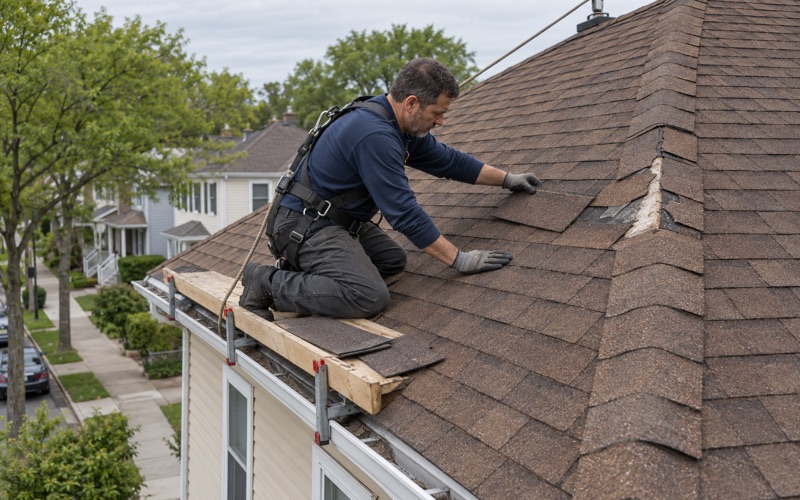
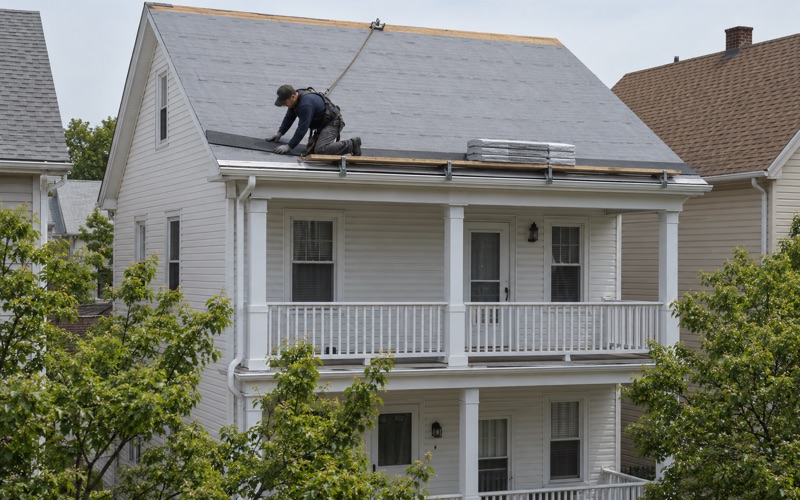
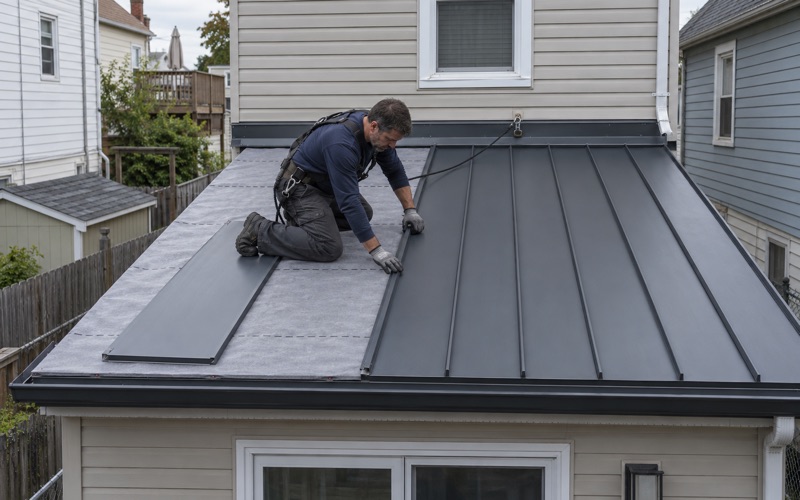
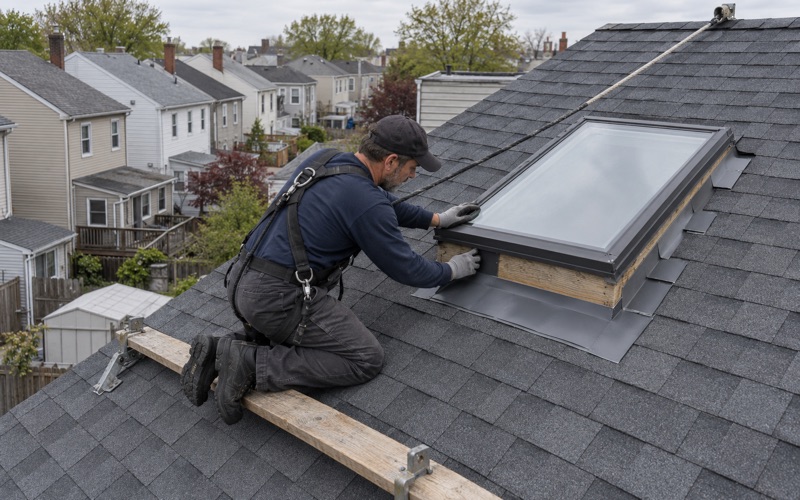
The order is fixed. The solar contractor disconnects and lifts the panels and racking. We tear off, inspect and replace the deck where needed, install new underlayment and flashing, and lay the roof. The solar contractor comes back to set the racking and panels on the new surface. Each handoff is a date on the schedule, and the roof is never left open waiting for someone who was not booked.
Any decking that turns out to be rotten once the old roof is off is photographed and shown to the owner before we replace it. The per-sheet price is already in the contract, so a soft section under the array is a known line item rather than a surprise invoice.
Flashing around mounts and penetrations
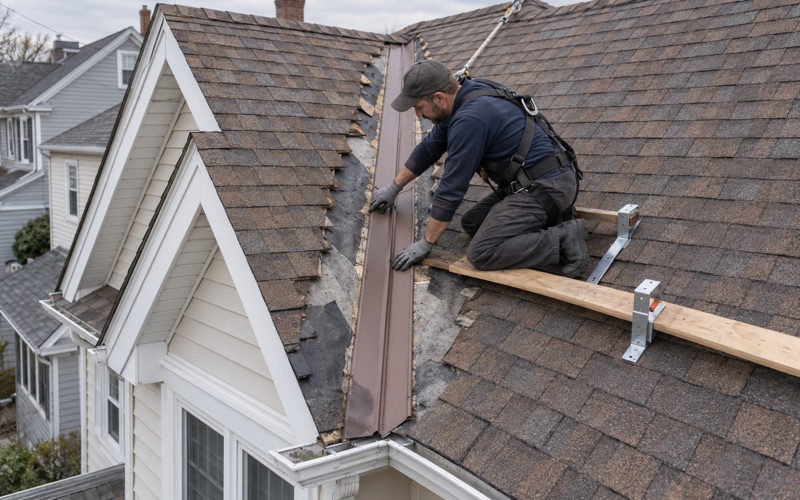
Every racking foot is a hole through the roof, and a re-roof is the chance to make each one right. Step, counter and chimney flashing is replaced with the new roof, never reused under it. We use ASTM D1970 self-adhering ice and water barrier in valleys, along the eaves and around penetrations, with synthetic underlayment over the rest of the deck, and we install drip edge at the eaves and rakes.
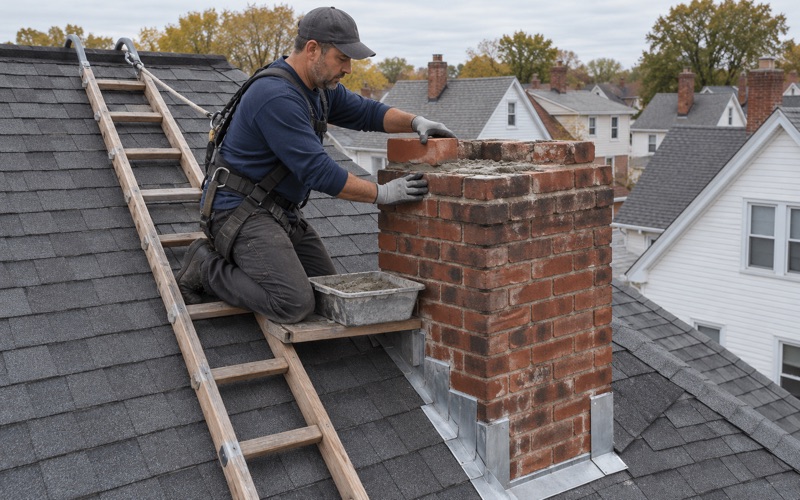
New pipe boots go on at every plumbing vent. If the house has a chimney, we look at the crown and the cricket while the roof is open, because a chimney leak that shows up after the panels are back on is a much larger job to reach.
Older Houses and Two-Family Homes in the Rose City
Madison’s housing is older and more varied than a newer suburb’s. Census estimates count 1,215 of the borough’s 5,781 housing units as built before 1940, and another 1,162 from the 1950s. A pre-war roof frequently has board sheathing, several layers of old covering and chimney flashing that has been patched more than once, and those details shape both the scope and the price.
What changes on a pre-war roof
On a detached one- or two-family house, replacing the existing roof covering is ordinary maintenance under N.J.A.C. 5:23-2.7, so no permit, inspection or notice is needed for that part of the work. Work that affects structural or fire safety falls outside that rule. If tear-off reveals rafters or sheathing that need structural repair, we stop and talk with the owner about what that means before going further.
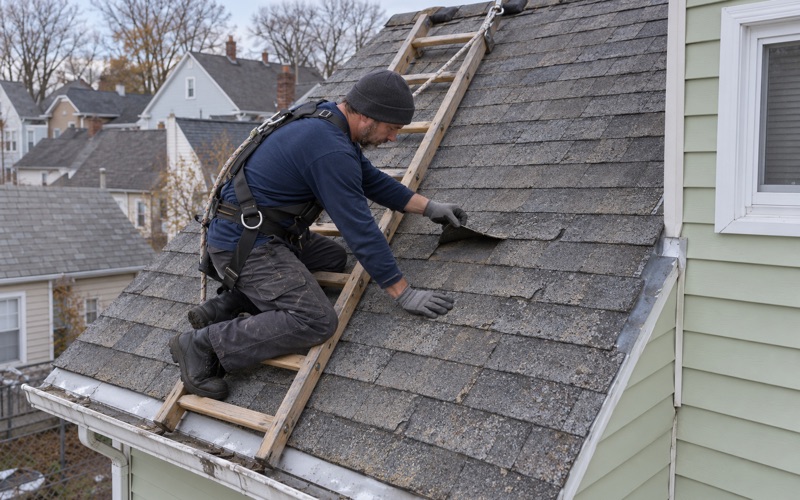
Layers matter as well. New Jersey’s rehabilitation subcode (N.J.A.C. 5:23-6) carries a re-roofing rule that calls for tear-off rather than another layer when a roof already has two or more layers, or is slate, wood shake or tile. On an older Madison house, we count the layers at the edge before quoting, so the scope reflects a full tear-off when one is coming. Where original slate survives and is sound, we repair it with copper nails and slate hooks instead of recommending a replacement it does not need.
Many older Madison houses also have painted trim and fascia. On homes built before 1978 we follow the EPA lead-safe work rule when that trim is disturbed, and the sidewalk, yard and gutters are cleaned at the end of every work day, including a magnet sweep for nails.
Planning around two households
Two-unit buildings hold 562 of Madison’s housing units, and renters occupy most of them. That means a roof is often decided by an owner who does not live directly under it. We schedule a two-family house with both units in mind: the tenant upstairs knows which days the crew is working and when we will need access to the attic or the top-floor ceiling.
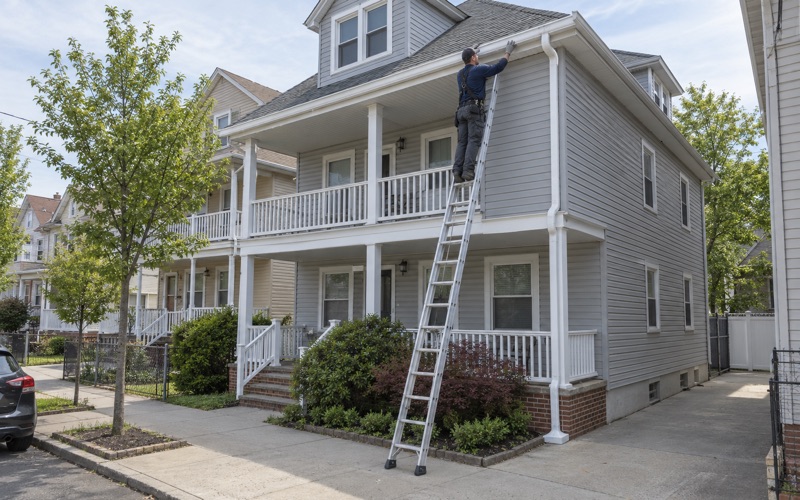
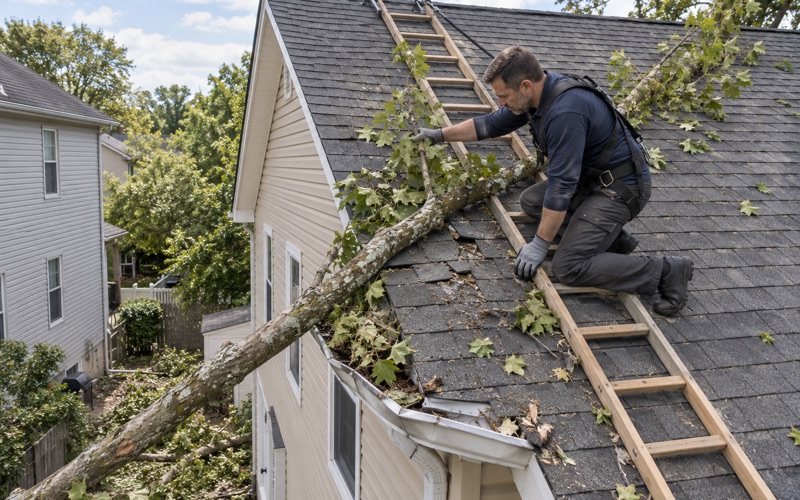
That access matters for leak calls too. Every leak inspection includes a look inside the attic or at the top-floor ceiling as well as on the roof, so the water is traced to where it actually gets in before anything is priced. On a house sharing a wall with a neighbor, we check both sides of the party wall line before deciding whose roof is at fault.
Downtown’s National Register District
Madison’s commercial center has been on the National Register of Historic Places since October 18, 1991, as the Madison Civic Commercial District. It covers the area around Main Street, Waverly Place, Lincoln Place, Prospect Street, Kings Road and Green Village Road, and nearby stands Madison Station, the 1916 stone Gothic Revival depot on Kings Road. The Hartley Dodge Memorial, home of borough government, faces the station.
Low-slope roofs behind the storefronts
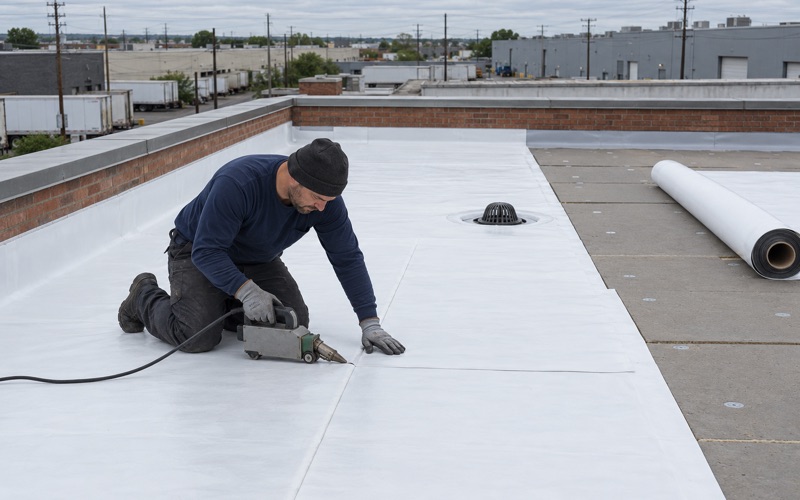
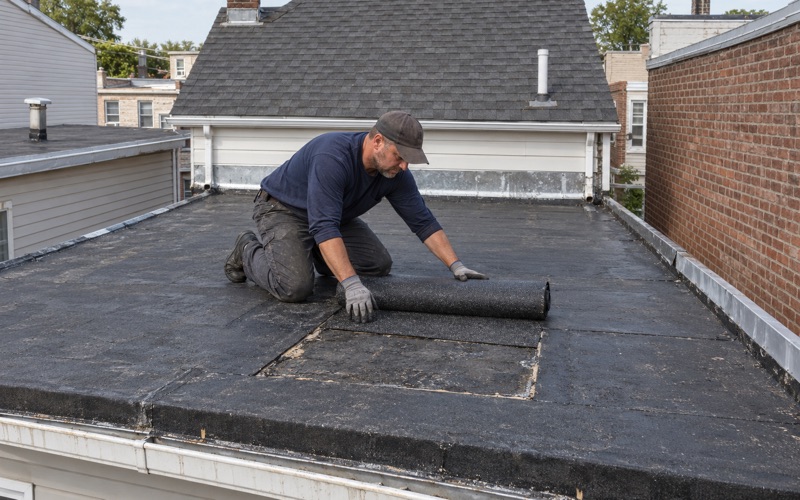
Many downtown buildings carry low-slope roofs behind a parapet. On those, we check the seams, the parapet coping and the drain or scupper, not just the patch someone can see from the hatch. Membrane choices run from torch-down modified bitumen to EPDM and TPO, picked for the building rather than by habit.
Box gutters, scuppers and leaders are cleared and tested with water before a flat-roof repair is called finished. A repair that looks dry on a sunny afternoon tells us nothing about where the next storm will go.
Historic review and who to ask
The borough has its own historic preservation chapter, adopted in 1999, and a Historic Preservation Commission that oversees exterior changes to registered historic sites. We do not claim to know which properties the commission reviews or what it asks for on a roof, so on a downtown or listed building, the owner should check with the borough before materials are chosen.
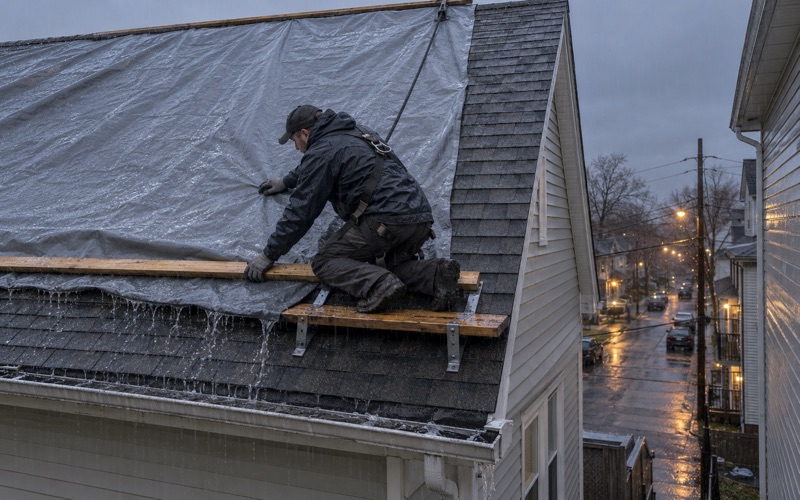
For weather, Madison falls in National Weather Service forecast zone NJZ008, Morris, issued from the Mount Holly office. When a wind or winter storm warning goes up for that zone, flat roofs downtown and the low-slope rear roofs on older houses are the first places we expect calls from, because a clogged scupper turns heavy rain into standing water within hours.
Construction questions go to the Building Construction department at 973-593-3064, temporarily working out of the Madison Volunteer Ambulance Corps building at 29 Prospect Street. Our contracts follow New Jersey’s home improvement rules, including the three-day cancellation notice, and when storm damage is the reason for the call, we photograph and write it up for the owner’s own claim and will meet the adjuster on site when asked.
- 20+ Years in Roofing
- Line-Item Written Estimates
- Daily Nail-Magnet Cleanup