Bayonne Superior Roofing handles roofing in Middlesex with more than 20 years behind us, and most jobs here turn on one question we settle before anything else: does the old roof come off, or can a new layer go over it? That answer sets the price, the schedule and how long the next roof will last.
We do not guess at it from the driveway. We look at the roof edges, go into the attic to read the underside of the deck, and note any soft spots underfoot. If the roof can still be repaired, you hear that from us first, and replacement only comes up when a repair would mean paying twice.
When a full replacement is the honest answer, the written scope lists tear-off, decking, underlayment, flashing and drainage as separate lines. That lets you lay a second estimate beside ours and compare the two item by item instead of trusting a single lump sum.
A Borough Built Between 1950 and 1970
Middlesex grew in one fast wave. Census counts put the borough at 5,943 people in 1950, 10,520 in 1960 and 15,038 in 1970, more than doubling in twenty years. The count dipped after that and stood at 14,636 in 2020.
The housing stock follows the same curve. Of 5,799 housing units counted in the latest five-year Census estimates, 1,485 were built in the 1950s and 1,706 in the 1960s, so 3,191 homes, or 55.0%, date from 1950 to 1969. Only 9.3% are older than that.
It is also a borough of owners in detached houses. Owners occupy 73.9% of occupied homes, and 66.8% of all units are one-unit detached houses.
What a Roof From That Era Has Been Through
A house built in 1958 or 1964 is now more than sixty years old. Asphalt shingles do not last that long, so a house from this wave is well past its first covering. We cannot tell from the street how many coverings have come and gone since, and no public record we have read answers that.
A house of this age may have had a tear-off at its last replacement and carry one layer, or it may have had a second roof nailed over the first to save a day of labor. The only way to know which you have is to look, and that is the first thing we do on a Middlesex visit.
Owners Deciding for Themselves
Because so many of these houses are detached and owner-occupied, the decision usually sits with one household rather than a landlord or an association. We write estimates for that reader, with each line explained and every assumption about the deck stated rather than buried.
A postwar house may have changed hands several times since it was built, and few owners inherit a record of what the last roofer did. Our written scope and the photos we take become that record for whoever owns the house next.
Looking for roofing closer to Red Bank? See Roofing Services in Red Bank.
Whole Streets Reaching the Same Roof Decision
Houses that went up on the same streets in the same few years were roofed with the same materials, under the same weather, at roughly the same time. That shared start tends to bring their replacements around in clusters, and a block of postwar houses can see several roofs replaced within a few seasons of each other.
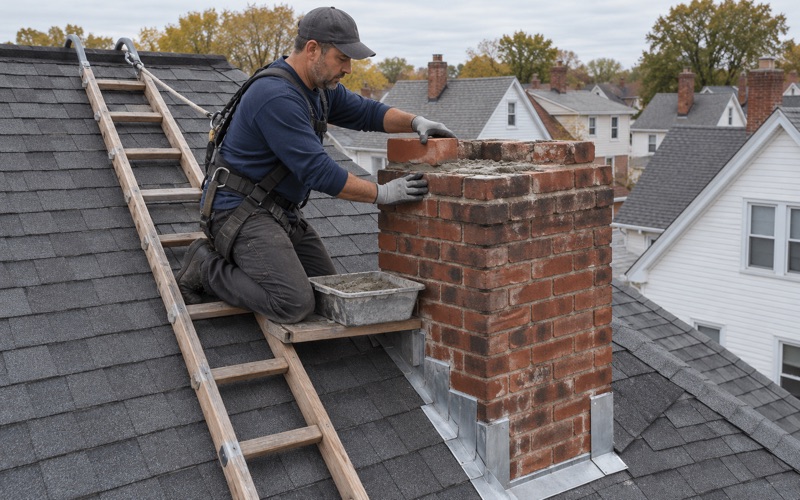
We do not treat that as a reason to replace a roof because the neighbor did. Two houses of the same age can be in very different shape depending on attic ventilation, tree cover, how the last crew flashed the chimney and whether anyone kept the gutters clear.
Sharing a Street With Other Jobs
When several houses on one street are replaced in the same season, crews, dumpsters and material deliveries compete for curb space. We set the dumpster and deliveries where your driveway and the street allow, and we keep a neighbor’s access open while the work is under way.
Signs Your Roof Has Reached Its Turn
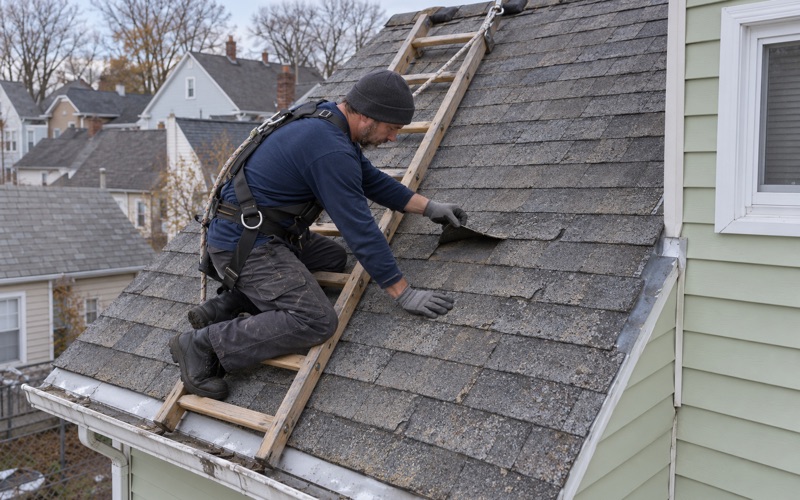
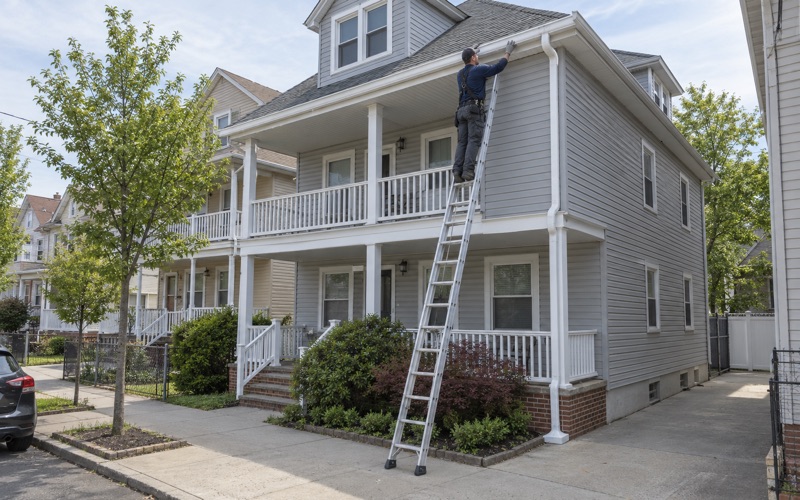
From the ground, look for curled or cupped shingle edges, bare patches where the granules have worn away, and dark streaks that keep spreading. Inside, a water ring on the top-floor ceiling or a damp spot around the chimney chase is worth a call before the next heavy rain.
When we come out for a leak, we check the attic or the ceiling below the roof as well as the shingles, so the water is traced to where it actually enters before we price anything. A stain under a valley often starts somewhere uphill of it.
Storm Warnings and Your Roof
Middlesex sits in National Weather Service forecast zone NJZ012, covered by the Mount Holly office, and borough police relay its severe thunderstorm warnings. The July 3, 2026 warning forecast gusts to 70 mph, the kind of wind that finds an aging roof’s weakest edge.
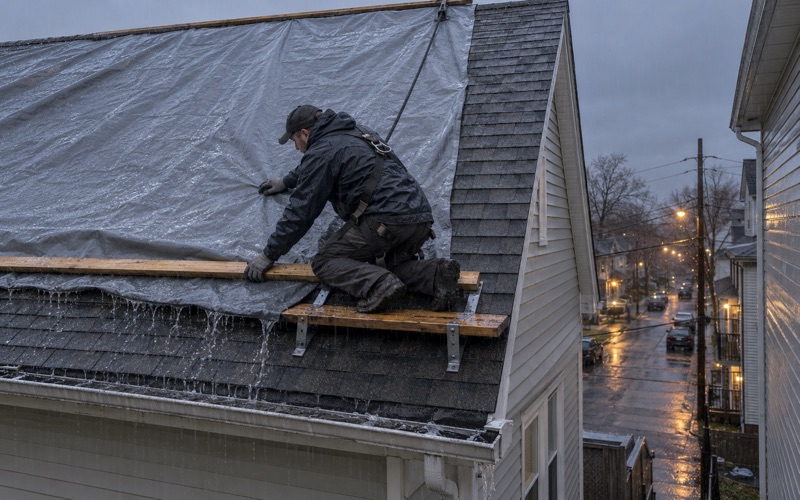
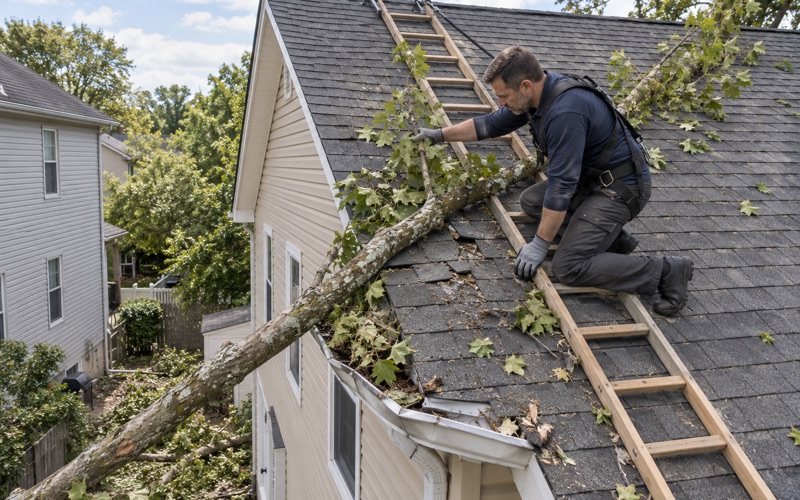
If wind does lift shingles, we photograph the damage and write it up for your own insurance claim, and we will meet the adjuster on site when you ask. A roof already near its turn is worth inspecting before the next warning rather than after it.
Tear-Off or Overlay on a Postwar House
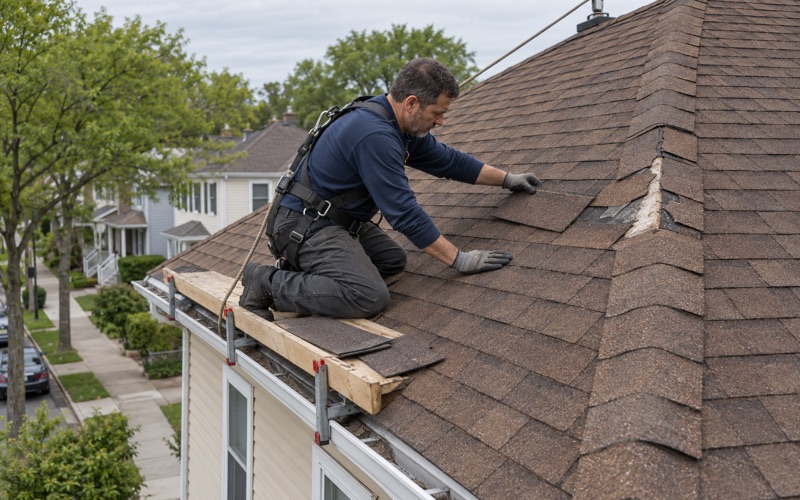
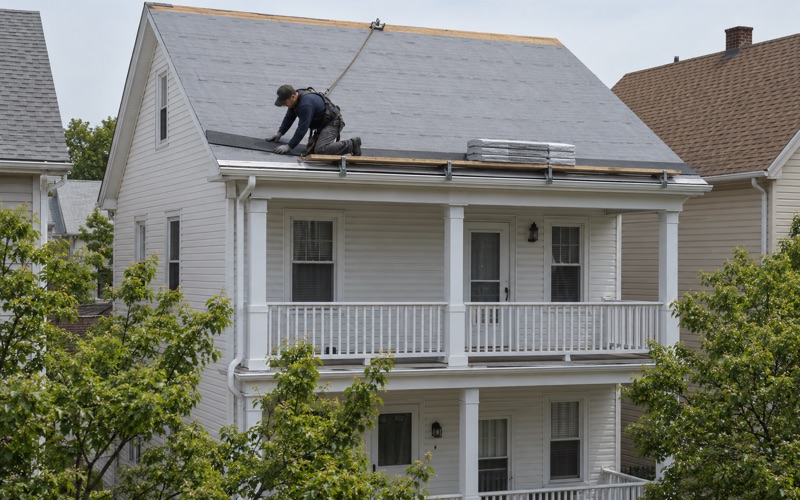
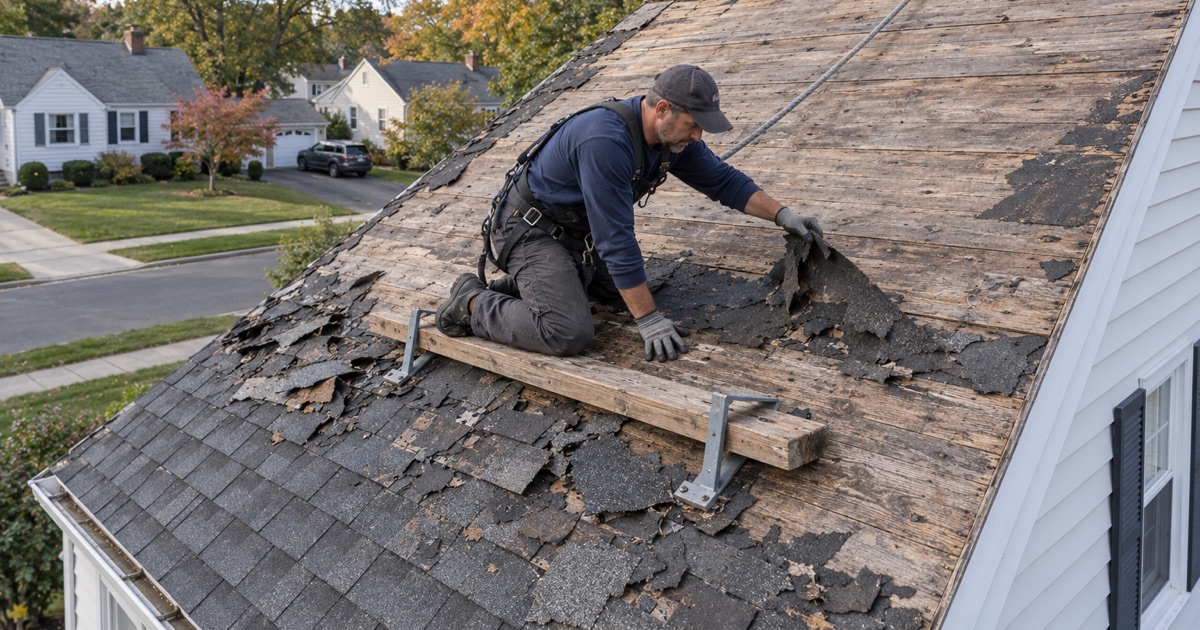
This is the decision at the center of a re-roof on a house this age, and it deserves a full answer. An overlay puts new shingles over the existing roof. A tear-off strips everything down to the deck, lets us see and repair the wood, and starts the new roof on a clean surface.
When the Rules Settle It
New Jersey’s rehabilitation subcode, N.J.A.C. 5:23-6, calls for a tear-off when a roof already has two or more layers, or when the existing covering is slate, wood shake or tile. On those houses there is no overlay option, and an estimate that offers one is a warning sign.
That is why we count layers before we price. We check at the eaves, along a rake edge and around a vent opening, because a second layer laid neatly over the first can be hard to spot from the yard.
When Overlay Is Allowed but Still a Question
On a single-layer roof an overlay is legal, and it costs less up front. It also hides the deck, adds weight, and means the next roofer pays for removing two layers instead of one. Flashing is the other catch: an overlay tends to reuse step and chimney flashing that has already served one full roof.
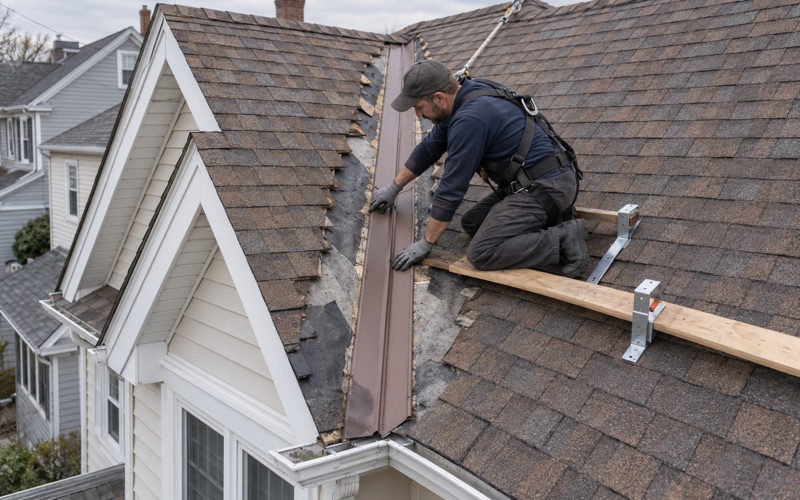
On a house from the 1950s or 1960s we usually recommend the tear-off, and we explain why in the scope rather than assuming it. Step, counter and chimney flashing goes on new with the roof, not reused under fresh shingles.
Decking Under the Old Layers
A roof deck that has carried several coverings over sixty-plus years can hide soft boards, old nail holes and rot near the eaves. When we find damaged decking during a tear-off, we photograph it and show you before replacing it, at the per-sheet price already written into the contract.
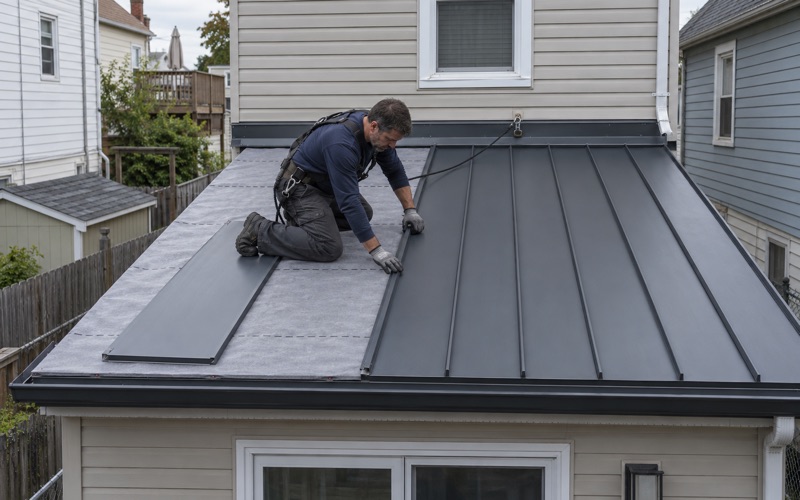
The new roof then goes on over ASTM D1970 ice and water barrier at the eaves and valleys, ASTM D8257 synthetic underlayment across the field, and drip edge at eaves and rakes. Architectural shingles such as GAF Timberline HDZ, Owens Corning Duration or CertainTeed Landmark carry wind ratings under ASTM D3161 Class F or ASTM D7158 Class H.
We balance ridge vent with soffit intake so the attic under the new roof breathes, and if solar panels sit on the roof, their removal and reinstall are booked before the tear-off date is set.
Attached Homes, Apartments and Older Houses
Permits at 1200 Mountain Avenue
Replacing the roof covering on a detached one- or two-family house is ordinary maintenance under N.J.A.C. 5:23-2.7, which requires no permit, inspection or notice to the construction office. Most of the borough’s housing falls under that rule, which leaves the homeowner as the check on the work and makes a line-by-line scope worth having.
Attached homes and buildings with three or more units are different. Census estimates count 542 attached single-family units in the borough and 585 units in buildings of 50 or more, and re-roofing them goes through the Uniform Construction Office at the Municipal Building, 1200 Mountain Avenue. Reviews there take 20 working days, so we build that time into the schedule.
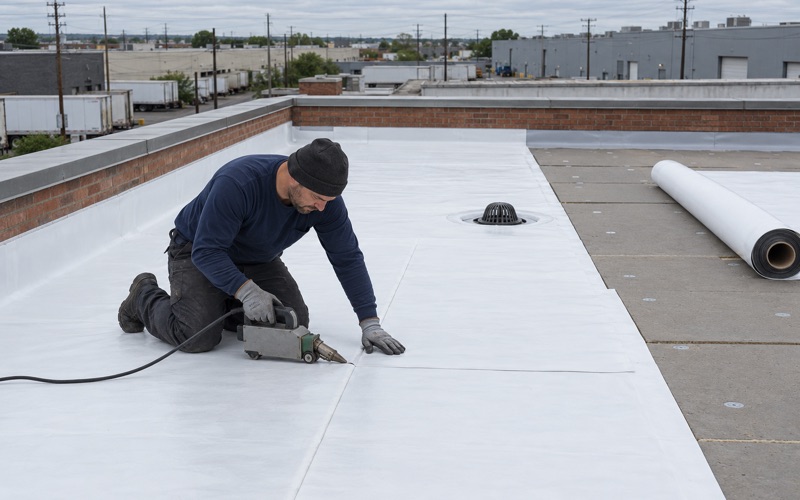
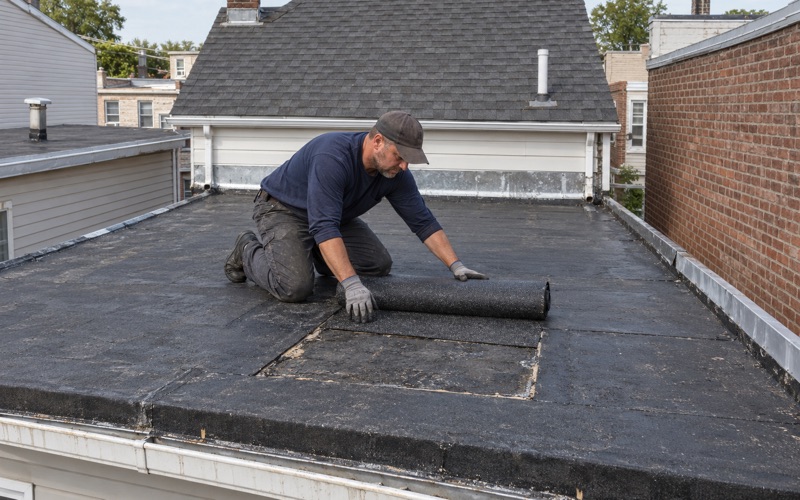
The office’s own page notes that obtaining permits is the property owner’s legal responsibility and advises holding final payment until a Certificate of Approval or Occupancy is obtained. On permit jobs we prepare the paperwork with you and plan around that sign-off. Where a building has a low-slope section, we check its seams, parapet coping and drain or scupper, not just the visible patch, and we clear and water-test box gutters and scuppers before a flat-roof repair is called finished.
Two-Family Houses and Shared Walls
In a two-family house, the upstairs unit is often a tenant’s home, and the crew’s arrival affects that household first. We schedule with both units in mind, so the upstairs tenant knows when we arrive and which rooms we may need to reach. When a leak runs along a party wall on an attached home, we trace it on both sides of the line before anyone’s roof takes the blame.
The Smaller Prewar Layer
Middlesex was incorporated in 1913 from part of Piscataway Township, and 540 of its housing units were built before 1950, 322 of them in 1939 or earlier. Those older houses bring different questions to a re-roof.
The Joseph and Minnie White House at 243 Hazelwood Avenue, in the Beechwood Heights section, was the childhood home of photojournalist Margaret Bourke-White and is listed on the New Jersey and National Registers.
Prewar houses more often have board sheathing instead of plywood, and the gaps between boards change how new shingles are fastened. Painted trim and fascia on any home built before 1978, which covers most of the borough’s housing, fall under the EPA lead-safe rule, and we plan the work around it.
Whatever the age of the house, each work day ends with the yard, sidewalk and gutters cleared and a magnet sweep for roofing nails. Our contracts follow New Jersey’s home improvement rules, including the three-day cancellation notice.
- 20+ Years in Roofing
- Line-Item Written Estimates
- Daily Nail-Magnet Cleanup