Bayonne Superior Roofing handles roof repair in Bayonne, NJ, serving surrounding cities including Roselle Park, North Arlington, Guttenberg, East Rutherford and Rutherford, with 20+ years of fixing pitched shingle roofs, slate, flashing and the low-slope roofs behind so many local two-family houses. Before we price anything, we give a straight answer on whether your roof can be repaired at all, and if it can, the repair is what we quote.
Most roof repairs come down to a small number of failure points: flashing at chimneys and walls, rubber pipe boots, lifted or missing shingles, open seams on a flat roof and clogged drains or scuppers. We find which one is letting water in by checking the attic or top-floor ceiling as well as the roof surface, so the repair is aimed at where the water enters rather than where it happens to show up.
Every repair is written up with photos of the damage, a description of the fix and the materials used. That record is useful if you sell the house, if a storm claim comes later or if you simply want to know what was done to your roof and why.
Residential Roof Repair
Shingle Roof Repair on Pitched Roofs
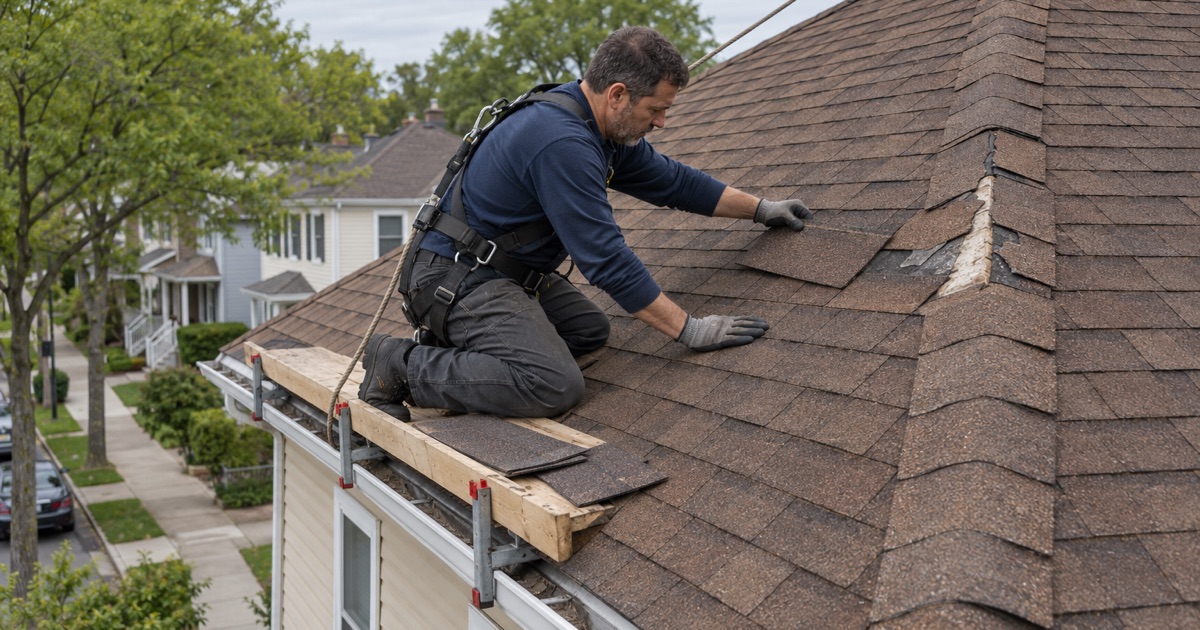
Shingles fail where wind gets under them and where the sealant strip has dried out with age. We replace missing and creased shingles with matched architectural shingles, hand-seal the neighboring tabs and check the underlayment that was exposed when the old shingle let go.
Where a slope has lost granules down to the mat or shingles are curling along a whole course, a patch will not last. We show you those areas in photos so you can see why a section repair or a replacement makes more sense than another round of spot fixes.
Flashing Repair at Chimneys, Walls and Dormers
Flashing is where most leaks on a pitched roof start. Step flashing runs under each shingle course along a sidewall or chimney, and counter flashing set into a reglet or mortar joint covers it from above. When the counter flashing pulls out of the joint or the step pieces rust through, water runs straight down the wall.
We replace failed step, counter and apron flashing rather than sealing over it with roof cement, which cracks within a season or two. At sidewalls that end above a gutter, we add kick-out flashing so water is turned into the gutter instead of down the siding.
Slate Roof Repair
Some older houses in the area still carry slate, which can last for generations when it is maintained. Broken and slipped slates are replaced one at a time, fastened with copper nails or copper slate hooks so the fasteners do not rust and let go again.
We never cover slate with shingles or tar. Under the New Jersey rehabilitation subcode, a slate roof has to be removed before a new covering goes on, so a careful repair is usually the better value until the slate itself has worn out.
Flat and Commercial Roof Repair
Low-Slope Rear Roof Repair
The flat section at the back of a two-family house is easy to forget and often the first part of the roof to leak. We check it at the seams, the parapet coping and the drain or scupper, not only at the visible patch where someone has already smeared roof cement.
Torch-down modified bitumen seams are reheated or capped with a new strip, EPDM seams are cleaned, primed and taped, and soft areas are cut open to check whether the insulation or decking underneath is wet. A wet section is replaced rather than sealed over, because trapped water keeps rotting the deck from inside.
Commercial Roof Repair for Mixed-Use Buildings
Storefronts with apartments above, small offices and light commercial buildings usually have flat roofs with more penetrations than a house: rooftop HVAC units, exhaust fans, vent stacks and roof hatches. Each is flashed into the membrane and each can leak at its curb or boot.
We repair modified bitumen, EPDM, TPO and PVC membranes and older built-up roofs, and we schedule commercial repairs around business hours where possible. Building owners get a written report they can keep for the property file or pass to an insurer.
Drain, Scupper and Coping Repairs
A flat roof that cannot drain will eventually leak. We clear roof drains and scuppers, reflash them into the membrane, repair conductor heads and leaders, and reset or replace loose parapet coping so water stops running down inside the wall.
Before a flat roof repair is called finished, the drains and box gutters are run with water to confirm they flow. Ponding that remains after the repair is pointed out to you with options for correcting the slope.
Repair or Replace: How We Decide
Signs a Roof Repair Will Hold
A repair makes sense when the damage is limited to one area and the rest of the roof still has years left: shingles lying flat and holding their granules, decking firm underfoot and flashing failures that can be isolated. In that case we fix the failed area and tell you honestly how much life the rest of the roof has.
Many of the leaks we see on otherwise healthy roofs come from one component, such as a cracked pipe boot or a single section of chimney flashing. Those are inexpensive fixes compared with a replacement, and there is no reason to buy a new roof to solve them.
When Roof Repair Stops Making Sense
Repeated leaks in different spots, soft decking across several areas, widespread curling or granule loss, and repairs that have already been layered on top of each other usually mean the roof has reached the end of its life. Spending on more patches at that stage only delays a replacement you will pay for anyway.
We photograph what we see and explain it in plain terms. If replacement is the better value, the estimate shows both options side by side so you can make the call with the numbers in front of you.
Our Step-by-Step Roof Repair Process
Step 1: Trace the Leak Inside and Out
We start in the room with the stain and follow the water up through the ceiling or attic, then check the roof above that point. On two-family houses we coordinate access with both units beforehand, so the upstairs tenant knows when someone needs to look in the attic.
Step 2: Photograph and Explain the Cause
You get photos of the damage and a clear description of what failed and why. If the cause is on a shared party wall, we trace both sides of the line before saying whose roof is responsible.
Step 3: Written Repair Estimate
The estimate lists the repair, the materials and any related work, such as replacing a rotted fascia board, as separate lines. Nothing is bundled into a single figure that cannot be compared.
Step 4: Repair, Test and Clean Up
We make the repair, water-test flat roof drains and outlets where they were part of the job, and clean the yard, sidewalk and gutters before leaving, including a magnet sweep for loose roofing nails.
- 20+ Years in Roofing
- Line-Item Written Estimates
- Daily Nail-Magnet Cleanup