Bayonne Superior Roofing approaches roofing in Rutherford with more than 20 years in the trade and one habit that shapes every estimate: we count what passes through the roof before we count shingles. A roof deck is rarely a clean plane. Pipes, ducts, fans and skylight curbs cut through it, and each opening is a place where water has a reason to get in.
Most of those openings belong to someone else’s trade. The plumber set the vent stack, an HVAC or electrical contractor ran the exhaust or the attic fan, and a carpenter framed the skylight. Our job is the roof around them: the boot, the flashing, the underlayment lapped the right way, and a finished surface that sheds water past every one of them.
That split matters when a re-roof becomes the moment a homeowner decides to move a bath fan, add a skylight or retire an old stack. We plan the roof so the other trades can do their part on the same schedule, and we explain how the paperwork for their work moves through the borough before anyone tears off a single course.
What Passes Through a Rutherford Roof
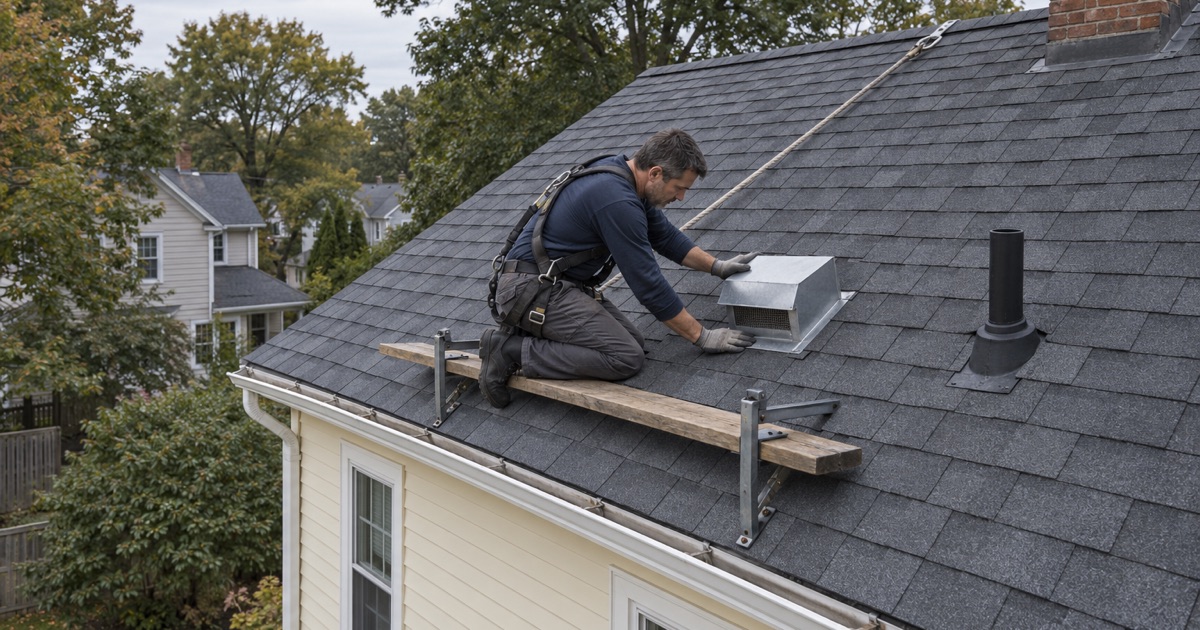
On a typical house we walk the roof and then go into the attic or the top-floor ceiling, because the inside view shows what the outside hides. A vent stack that looks fine from the street may have a cracked boot underneath, and a stain on the bedroom ceiling may sit two rafters away from the opening that actually leaks. We trace the water to where it enters before we price anything.
Vent stacks and pipe boots
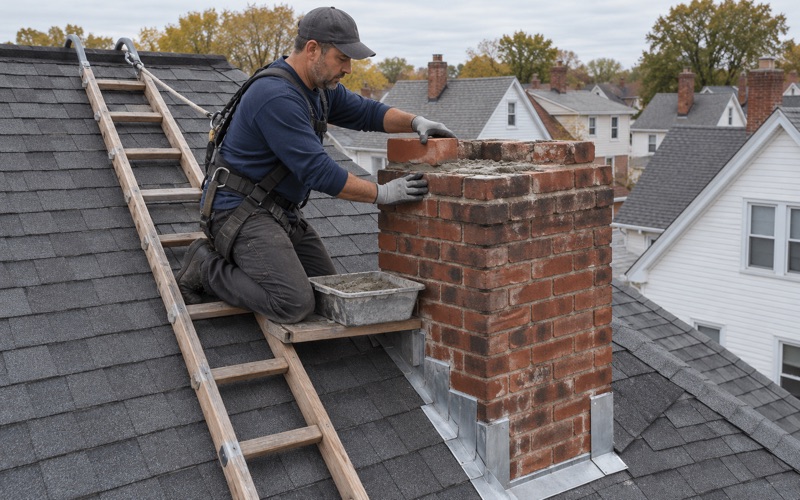
Plumbing vent stacks are the most common penetration we see. On an older stack, a lead flashing boot is often the right answer, because lead can be dressed tight around cast iron and holds up for a long time. Newer PVC stacks usually take a pipe boot with a rubber collar, which we replace with the roof rather than leaving an old collar to crack under new material.
If a stack is abandoned or capped below the roof line, that is a plumbing question, not a roofing one. We point it out, photograph it, and leave the decision about removing it to the owner and their plumber. We do no plumbing work ourselves.
Where several stacks come through close together, we look at how the shingle courses and the flashing will lap around each one. Two boots set too near each other can trap water between them, and that is easier to solve with the deck bare than after the field shingles are down.
Bath and kitchen exhaust ducts
A bath or kitchen fan that vents into the attic instead of through the roof can soak the underside of the deck every winter. When we find one, we show the owner, because a new roof over a wet deck will not last as long as it should. Running that duct to a proper roof or wall cap is mechanical or electrical work for the right contractor; our part is the flashed opening and the cap where it meets the roof.
Attic fans and roof ventilation
Powered attic fans sit on a curb cut into the deck, and many of them were added years after the roof was built. During a re-roof we look at how the attic breathes as a whole. Sometimes a ridge vent with soffit intake, sized by net free area, does the job the fan was installed to do. Sometimes the owner wants to keep the fan. Either way, the fan’s wiring stays with an electrician.
Looking for roofing closer to Fairview? See Fairview Roofing.
Skylights and the Framing Around Them
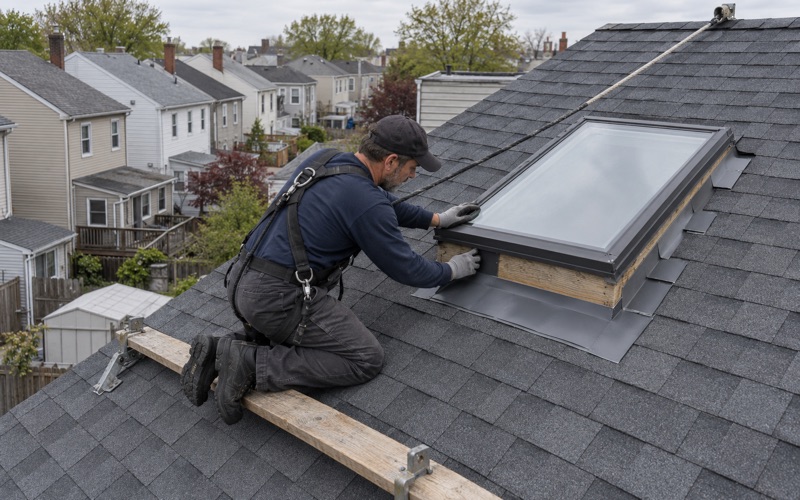
A skylight is the largest hole most homeowners ever put in a roof, and it fails most often at the flashing rather than the glass. When the old roof comes off, the curb and the framing around the opening are exposed, which makes a re-roof the cheapest time to deal with them.
Curb-mounted and deck-mounted units
Curb-mounted skylights sit on a raised wooden box built up from the deck. Deck-mounted units fasten straight to the sheathing and rely on a factory flashing kit. We identify which kind you have, check the curb for rot and the glazing seal for fogging, and give a straight answer on whether the unit can stay before replacement is discussed.
Flashing the opening with the new roof
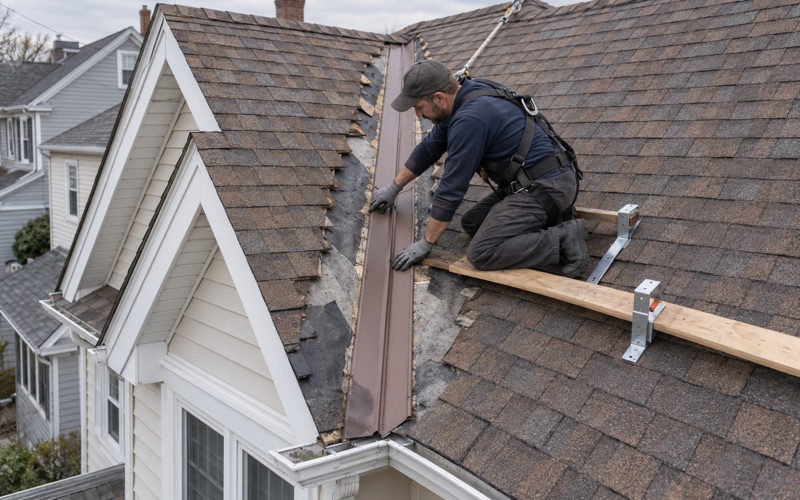
We replace step flashing, head flashing and the apron at the bottom of the skylight with the roof. Reusing old flashing under new shingles is how a new roof starts leaking in the first year. Self-adhering ice and water barrier meeting ASTM D1970 goes around the curb before the flashing, so a gap in the metal does not become a gap in the roof.
Adding or closing a skylight during the job
Some owners use a re-roof to add a skylight or to close one they never liked. Cutting a new opening means cutting a rafter or working between them, and closing one means new framing and sheathing. That carpentry happens while the deck is open, and we schedule it so the roof is never left exposed overnight.
Damaged sheathing found around any opening is photographed and shown to the owner before it is replaced, at the per-sheet price already written into the contract. Our written scope lists tear-off, decking, underlayment, flashing and drainage as separate lines, so an estimate that includes the skylight work can be compared item by item with one that does not.
Building, Plumbing, Mechanical and Electrical as One Package
Under New Jersey’s Uniform Construction Code, replacing the roof covering on a detached one- or two-family house is ordinary maintenance under N.J.A.C. 5:23-2.7, so the shingle work on its own does not call for a permit. The trade work that sometimes rides along with a re-roof is a different question, and it is one the borough answers case by case, not one we answer by assumption.
What the borough FAQ says
The Borough of Rutherford’s building permit FAQ says a permit is generally needed when you construct, enlarge, alter, repair, move, remove, improve, convert or demolish a building. The same FAQ says building, plumbing, mechanical and electrical permits are processed as one total package. It is a general statement about how the office works, and it does not list which roof penetration needs what.
So when a re-roof picks up trade work, the practical point is that the pieces do not travel as separate filings. If your plumber, electrician or HVAC contractor determines their part of the job needs a permit, it goes through the same office together with any building work, rather than as unrelated applications on different timelines.
Who decides what applies
We do not tell homeowners that a skylight, a fan or a vent needs a permit, because the borough does not publish that list and the answer depends on the specific work. The contractor doing each trade’s work knows their own code, and the Building Department makes the call. Our role is to make sure the roofing schedule leaves room for whatever that office requires.
Our written scope makes the line between trades visible. Roof items such as boots, curb flashing and the cap where a duct exits are priced by us. Anything that moves a pipe, a wire or a duct inside the house is marked as the owner’s other contractor’s work, so nobody assumes the roofer has it covered.
Why this matters on owner-occupied homes
Rutherford has 3,458 owner-occupied one-unit detached houses, about half of the borough’s occupied homes. Census figures put 42.8 percent of Rutherford’s housing units in 1939 or earlier and another 34.4 percent in 1940-1959. On houses of that age, a re-roof often turns up old stacks, retrofitted fans and skylights added by earlier owners. Knowing that trade work moves as one package helps an owner plan the whole job instead of finding out about a second filing halfway through.
On a two-family house, we also schedule with both units in mind, so the upstairs tenant knows when the crew arrives and when attic access is needed. If solar panels are on the roof, their removal and reinstall go into the schedule from the start.
Filing with the Building Department at Borough Hall
The Building and Zoning Department is at Borough Hall, 176 Park Avenue, on the main level. It is open Monday through Friday from 8:30 a.m. to 4:30 p.m., and the Construction Official is Chris Salviano. Building inspections can be reached at 201-460-3010.
Sending paperwork by email
The department takes permit correspondence at permit@rutherfordboronj.com. For a homeowner coordinating a plumber and an electrician alongside a roof, email is the practical way to ask what applies before work starts, and it leaves a written answer everyone on the job can see.
The Meadowlands District question
Part of Rutherford lies inside the Hackensack Meadowlands District, where land use falls under the New Jersey Sports and Exposition Authority. Its rule bars remodeling or reconstruction without a zoning certificate, except for demolition and maintenance. If your house is in that part of the borough and the job goes beyond a straight re-roof, asking the authority’s Zoning Officer of the Day before work starts is a short call that settles it.
How we fit the roof around the filings
We set our tear-off date after the other trades know where they stand, not before. A skylight opening or a rerouted exhaust duct is far easier to flash on a bare deck than to retrofit into a finished roof, so sequencing the work matters as much as the work itself. Once the roof is down, any later trade visit that needs a new opening means cutting into fresh shingles, which is the outcome good scheduling avoids.
Our contracts follow New Jersey’s home improvement rules, including the three-business-day cancellation notice, and every day ends with the sidewalk, yard and gutters cleaned and a magnet sweep for roofing nails. When the last penetration is flashed and the last course is down, the roof should shed water past every pipe, duct and curb that runs through it.
- 20+ Years in Roofing
- Line-Item Written Estimates
- Daily Nail-Magnet Cleanup