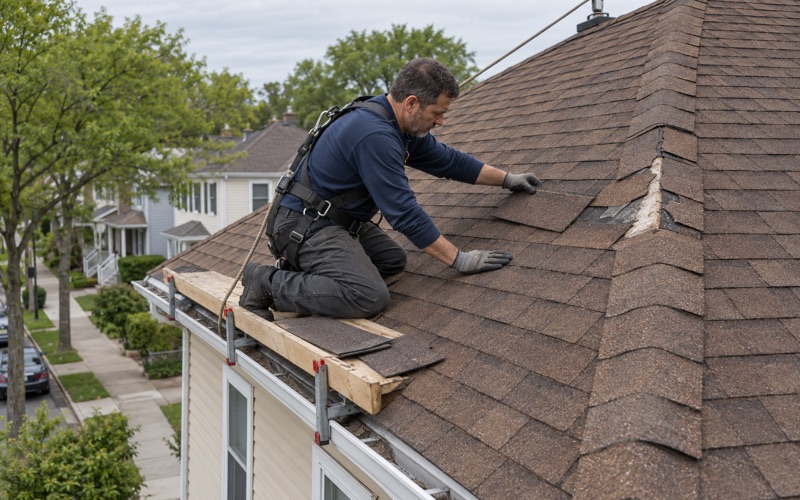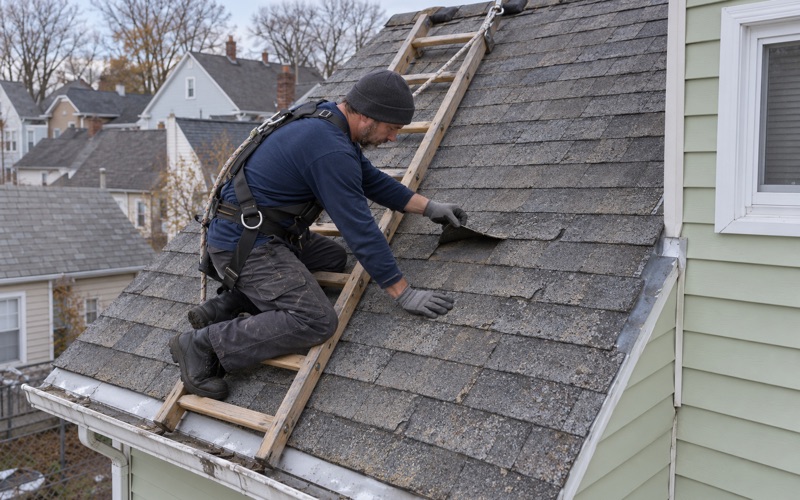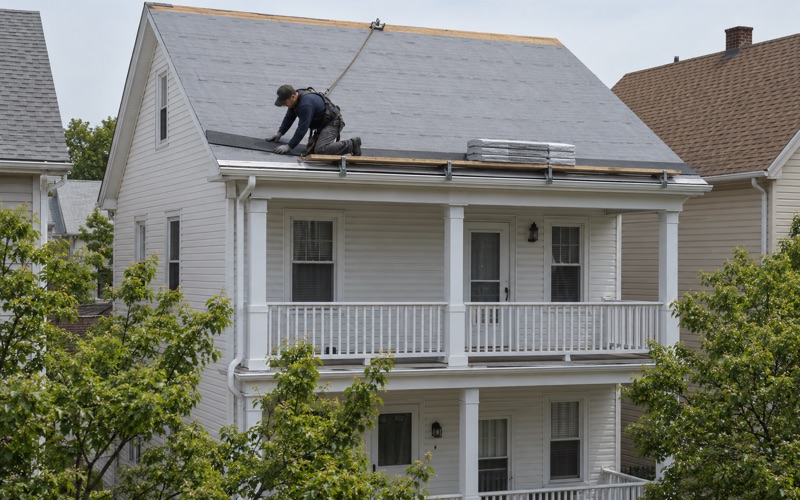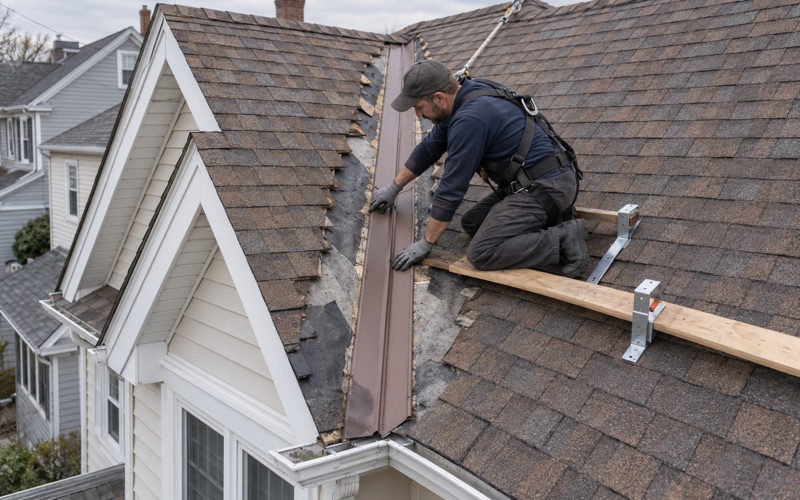
Bayonne Superior Roofing brings more than 20 years of work to roofing in Wood-Ridge, and the part of a job most homeowners read least carefully is the one we spend the most time on before a ladder goes up: the contract. A roof is a large purchase made mostly out of sight. The paperwork is the only place an owner can check, in advance, what is going on the house, when, and on what terms the last check gets written.
New Jersey sets out what that paperwork has to hold, and it is more specific than many people expect. For any home improvement job priced above $500, the agreement must be written and signed, must name the work and the principal products, must give the total price and must say when the work starts and finishes. It also controls the order of events at both ends of the job.
This page walks through those requirements the way they play out on a roof here. None of it is legal advice. It is how we write our own contracts, and it is a fair checklist for reading anyone’s estimate, including ours.
What a Wood-Ridge roofing contract has to say
The rule behind all of this is N.J.A.C. 13:45A-16.2, the state’s home improvement practices regulation. Paragraph (a)12 covers contracts with a purchase price over $500, which takes in essentially every roof replacement and most real repairs. Those contracts, and any change to their terms, must be in writing and signed by all parties.
The written contract, line by line
The regulation lists what goes in: a description of the work, the principal products and materials, the total price including any finance charges, and the dates or time period for starting and completing the job. A one-line estimate reading “new roof, $X” does not meet that standard, because it leaves the owner nothing to hold the finished roof against.
Our written scopes go further than the minimum by breaking the job into separate lines: tear-off, decking, underlayment, flashing and drainage. That layout is what lets a homeowner set two estimates side by side and compare them item by item, instead of comparing two totals that may describe different roofs.
Changes after signing
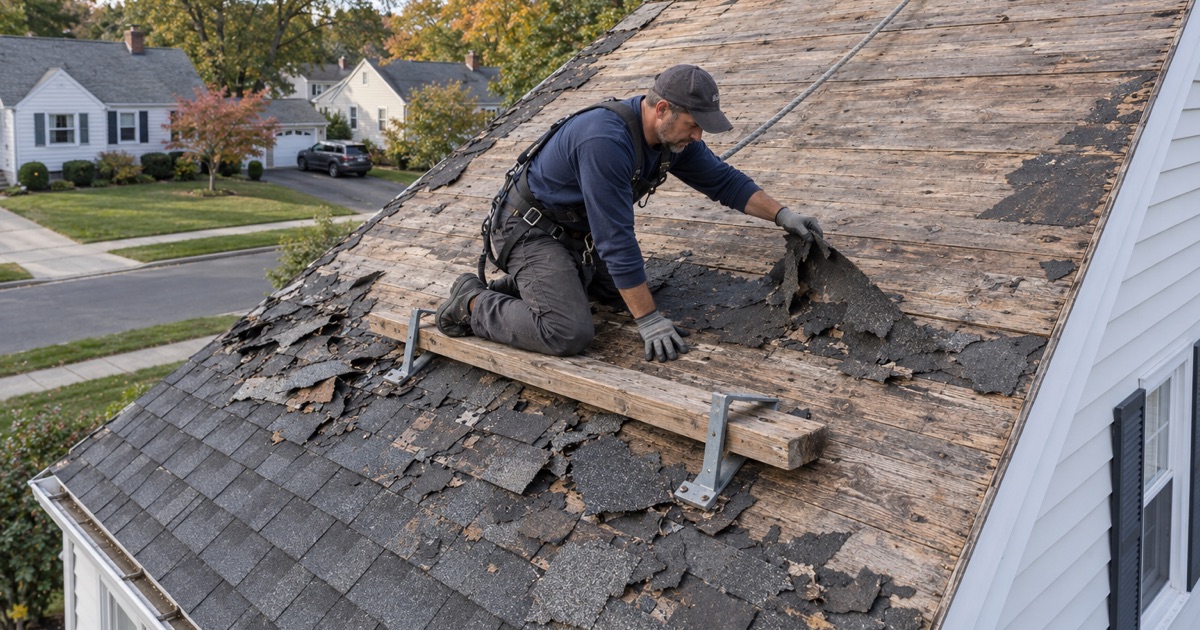
Roofs hide things. When the old shingles come off, the decking underneath is sometimes soft or delaminated, and the job changes. The rule says changes to the contract terms must also be in writing and signed. We handle the most common change in advance: damaged decking is photographed and shown to the owner before any sheet is replaced, at a per-sheet price already set in the contract, so the change has a known cost before it happens.
Insurance work gets the same paperwork. When storm damage is behind the job, we photograph and write it up for the owner’s own claim, and meet the adjuster on site when asked; the contract that follows still names the products, the price and the dates like any other.
Three business days to reconsider
State law gives a homeowner three business days to cancel a home improvement contract over $500, under N.J.S.A. 56:8-151, and the cancellation notice belongs in the contract itself. Ours includes it. A contractor pressing for a start date inside that window is rushing past a right the law gives the owner.
Looking for roofing closer to Little Ferry? See Little Ferry Roofing.
Shingles and underlayment named by make and model
The phrase in the regulation is “name, make, size, model” of the principal products. On a roof, that is a short list, and every item on it matters to how long the roof lasts.
The shingle itself
Architectural, or laminated, shingles are the usual choice on a pitched roof today, and the major lines are not interchangeable. GAF Timberline HDZ, Owens Corning Duration and CertainTeed Landmark each come with their own wind ratings, warranty terms and color ranges. A contract that says “architectural shingles” without naming the line leaves the choice to whoever orders the material. We write the manufacturer, the product line and the color into the agreement.
Where wind or impact ratings are part of why an owner chose a product, those belong in the description too, such as ASTM D3161 Class F or ASTM D7158 Class H for wind, or UL 2218 Class 4 for impact, so the owner can check that the delivered bundles match what was priced.
What goes under the shingles
Underlayment is where cheaper bids often quietly differ. A self-adhering ice and water barrier meeting ASTM D1970 along the eaves and in valleys is a different product, at a different cost, from felt paper. Synthetic underlayment made to ASTM D8257 is another distinct choice. Each should be named, with where it goes on the roof.
Flashing and edge metal
The contract should also say what happens at the edges and penetrations: drip edge at eaves and rakes, pipe boots, and step, counter and chimney flashing. Our practice is to replace step, counter and chimney flashing with the roof rather than reuse the old metal under new shingles, and the contract says so in writing. Ventilation belongs here as well; a ridge vent only works with enough soffit intake, and the scope should name both.
If a roof carries solar panels, the removal and reinstall belong in the contract as their own line, with the dates planned around them rather than discovered on the day of tear-off. The same goes for gutters: if new seamless aluminum gutters and leaders are part of the job, the contract should say so, with the size and the run.
Start and finish dates, and permits issued before work begins
The regulation requires the dates or time period within which the work is to begin and be completed. On a roof that needs a few dry days in a row, the honest version is usually a window rather than a single morning, with a stated finish time once the old roof is off. Leaving a house open to the weather is the one delay an owner cannot afford, so we plan tear-off in sections no larger than the crew can close up the same day.
Why the house stock shapes the schedule
Half of Wood-Ridge’s occupied homes, 49.6 percent, are owner-occupied detached houses, and much of the housing is older: 20.2 percent was built in 1939 or earlier and another 28.4 percent between 1940 and 1959. Roofs on houses of that age may have been covered more than once, and a tear-off through several layers takes longer and turns up more decking surprises than a single layer does. A realistic completion date accounts for that before the contract is signed, not after.
Two units, one schedule
Where a Wood-Ridge house holds two units, the start date matters to more than the owner. We schedule two-family houses with both units in mind, so the tenant upstairs knows when the crew arrives and where access to the attic or rear roof is needed. That notice goes out once the contract dates are fixed, not the morning of the job.
Permits come first
Paragraph (a)10 of the same rule says the contractor must not start work until all applicable state or local building and construction permits have been issued. Whether a particular roofing job needs one is a separate question. In New Jersey, replacing the roof covering on a detached one- or two-family house is treated as ordinary maintenance under N.J.A.C. 5:23-2.7. Work that goes beyond the covering can be a different matter, and the borough is the authority that decides.
Asking the borough
The Borough of Wood-Ridge Construction Department states that building permits are required for most work and suggests calling to find out whether a given job needs one. The office is on the second floor of the Municipal Building at 85 Humboldt Street. Permits are issued from 9:00 a.m. to 3:00 p.m., and applications are paper forms from the rack by the office door. When a job does need a permit, it is issued before our crew starts, and the contract says who is pulling it.
Inspection certificates before final payment
The end of the job has its own rules. Where inspections are required, paragraph (a)10 says copies of the inspection certificates must be given to the homeowner when construction is completed and before final payment is due or a completion slip is requested. Separately, the rule bars a contractor from asking for final payment or a completion certificate before the contracted work is actually finished.
What finished means on a roof
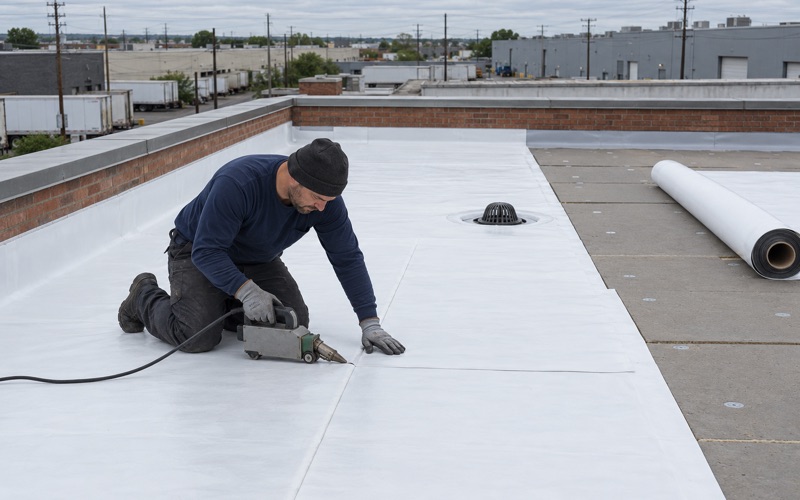
For us, a roof is not finished when the last shingle is nailed. Gutters and leaders are cleared, low-slope sections are checked at the seams, coping and drains, and box gutters and scuppers are run with water before a flat-roof repair is called complete. The sidewalk, yard and gutters are cleaned at the end of each work day, with a magnet sweep for nails, so the final walk-through is about the roof rather than the debris.
Scheduling the inspection
In Wood-Ridge, inspections run Monday through Friday and are scheduled by calling 201-939-5188. On a permitted job we build the inspection into the finish date in the contract, so the owner is not left holding a roof that is done but not yet signed off. The certificate goes to the homeowner with the final invoice, not after it.
Holding the last payment
The practical effect is simple. A homeowner should not be asked for the final payment until the work in the contract is complete and any required inspection certificates are in hand. Tying payment to those two things is not a favor a contractor grants; it is how the state wrote the rule, and our contracts follow it.
Before anything is signed
Not every call ends in a contract for a new roof. A leak often has a smaller answer, and we trace the water through the attic or top-floor ceiling as well as on the roof before pricing anything. If the roof can be repaired, we say so first. If replacement is the better choice, the written contract described above is where that conversation lands, with the products, the dates, the permit question and the final payment terms all on paper.
- 20+ Years in Roofing
- Line-Item Written Estimates
- Daily Nail-Magnet Cleanup